
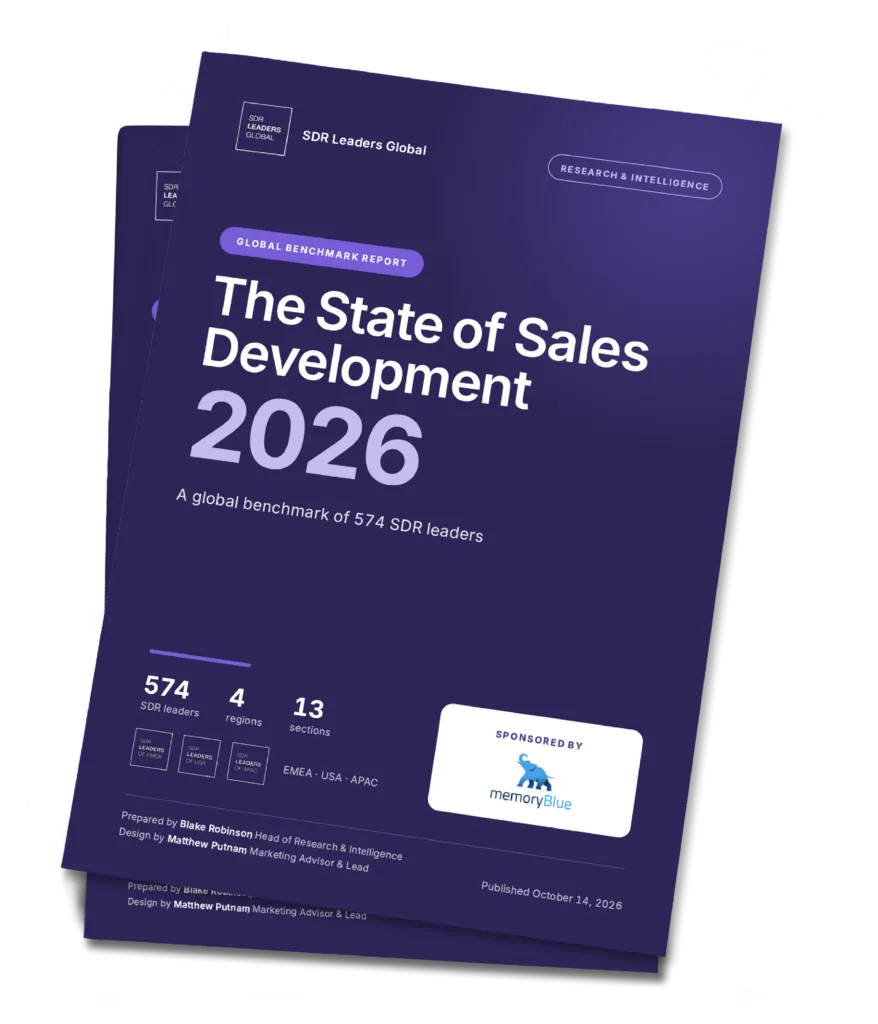
Is the SDR role disappearing? The data says no. 53% of organizations grew SDR headcount last year, SDR teams hit 82% of quota against 76.5% for AEs, and 72% of leaders still name the phone as their top pipeline channel. Here’s what’s changing, what’s driving performance and what to prioritize next.
Table of contents
- Introduction
- Sales development report dashboard
- SDR headcount in 2026
- SDR vs AE quota attainment
- Pipeline channels and sequences
- AI in sales development
- What drives SDR performance
- The SDR maturity quadrant
- Tenure and the promotion cliff
- Coverage and team structure
- SDR pay by region
- Outsourced SDRs
- Sales development by region
- Report takeaways
1. Introduction
For years, the headline has been the same: AI is coming for the SDR. So we asked the people running SDR teams what’s actually happening.
The State of Sales Development 2026 benchmarks 574 sales development leaders across North America, EMEA, APAC and the UK, surveyed between 26 August and 20 September 2026. The research was carried out independently by SDR Leaders Global and sponsored by memoryBlue.
The short version: the SDR function is growing, it hits plan more often than the sales teams it feeds, and budget explains surprisingly little of its performance. What does show up in the data is how the function is run.
In this report, we cover:
- Where SDR headcount is growing, and why cuts follow sales misses rather than SDR misses.
- What actually moves SDR attainment and tenure: enablement, AI breadth, activity load and work design.
- How the role differs across four regions, from pay to promotion.
2. Sales development report dashboard
The SDR industry in eight numbers.
- 53% of organizations grew SDR headcount (net +30)
- 82% average SDR quota attainment, vs 76.5% for AEs
- 72% say phone is their #1 pipeline channel
- 1 vs 18.7 months of SDR tenure: EMEA vs North America
- +4.6 pts SDR quota attainment linked to dedicated enablement
- +1.45 pts SDR quota attainment for each extra way a team uses AI
- 11% of SDR orgs use outsourced SDRs; 3x more likely under $10M revenue
- 79% · 84% · 91% SDR quota attainment in North America, EMEA and APAC
3. SDR headcount in 2026: Is the SDR function growing?
+30 net SDR headcount growth. 53% grew, 25% held steady, 23% cut.
Despite years of “the SDR is dead” commentary, 53% of organizations grew SDR headcount over the past year. 25% held steady and 23% cut. That’s a net +30 in favor of growth, and it’s positive in every region.
Net growth by region:
- North America: +35
- APAC: +24
- EMEA: +22
- UK: +21
Growth is strongest in smaller companies and slows as revenue rises. Enterprises above $1B are still growing on balance, but 28% of them cut headcount, the highest rate of any revenue band.
Net growth by company size: +43 under $10M revenue, +38 at $10–100M, +23 at $100M–$1B and +16 at $1B+.
Is your company entering a new vertical or region this year? Most companies that did grew their SDR team.
Expansion is a major driver. Half of organizations (51%) entered a new vertical or geography in the past year. Among them, 62% grew SDR headcount, against 37% of those that didn’t. When the SDR team was brought into an expansion, it supported it 95% of the time.
One caution: the more senior the respondent, the less optimistic the picture. Net growth is +39 among Managers, +20 among Directors and +7 among Senior Directors and VPs. Senior leaders see the whole organization, so their view is likely the more reliable read.
4. SDR vs AE quota attainment: Are SDRs outperforming the teams they support?
SDRs 82% vs AEs 76.5% average quota attainment.
SDR teams hit plan more often than the sales teams they feed. Average SDR attainment is 82%, against 76.5% for AEs. 62% of leaders report SDR attainment of 80% or more, against 47% for their sales team.
At the bottom end, 36% of sales teams average below 70%, compared with 21% of SDR teams. AEs out-attain their SDR team in only 23% of organizations. And the average SDR team sources about half of company pipeline.
So why do SDR teams get cut? The data points somewhere uncomfortable.
Where SDR teams were cut:
- SDR attainment: 81%, exactly the same as teams that grew
- AE attainment: 72%, against 77–79% where SDR headcount held or grew
SDR attainment was 81% whether a team grew or was cut. What differed was the sales team: AE attainment averaged 72% where SDR headcount was cut, against 77–79% where it held or grew. The pattern suggests SDR teams absorb cuts for misses further down the funnel. The survey didn’t ask why cuts were made, so treat it as a pattern, not proof.
5. Pipeline channels and sequences: Is the phone still #1?
72% of SDR leaders say the phone is their #1 pipeline channel. Email follows at 19%, social at 6%.
AI-written emails and automated sequences haven’t knocked the phone off the top spot. 72% of SDR leaders say it generates the most pipeline, ahead of email (19%) and social (6%). Phone leads in every region, at 70–83%.
That doesn’t mean other channels fail. There’s no measurable gap in SDR attainment by primary channel, or by qualification framework (BANT 35%, MEDDPICC 32%, plus SPICED and custom). The phone is simply what produces pipeline for most teams.
How long is your main sequence? The most common is 9–12 touchpoints (37%) over 15–21 days (36%).
6. AI in sales development: Is AI replacing SDRs?
78% of SDR teams already use AI.
AI is now standard kit. 78% of SDR teams list it in their toolkit, and breadth matters: each additional AI use case is associated with 1.45 points higher SDR attainment (p=.001).
The seven use cases measured were account and persona research, message creation, data review, training and coaching, list building, ICP building and intent monitoring.
Autonomous AI SDR agents get far more attention than use. Only 16% use them (13% alongside their team, 3% as a partial replacement). 25% are evaluating and 59% have never used them.
AI SDR agents at a glance:
- 16% use them (13% alongside their team, 3% as a partial replacement)
- 25% are evaluating them
- 59% have never used them
Does replacing people with AI SDRs shrink the team? Net headcount growth was +39 among organizations that never used AI SDRs, +25 among those using them alongside the team, and −7 among those using them as a partial replacement.
How many of the seven AI use cases does your team cover today?
Of the 14 organizations using AI SDRs as a partial replacement for people, half cut headcount. The group is too small to generalize from, but it’s the first data point on the question.
“AI is proving its value as an enabler of SDR performance, not necessarily as a replacement for SDRs themselves.” – Jane Serra, Chief Marketing Officer, memoryBlue
7. What drives SDR performance?
More tools, bigger budgets and higher activity targets don’t automatically buy better results. Two investments stand out.
What shows up in SDR attainment (with controls for size and region):
- SKO or offsite: +6.9 points
- Dedicated enablement: +4.6 points
- President’s Club: no significant link
- Professional development budget: no link
Enablement is the broadest lever. A dedicated enablement function is the only investment linked to SDR attainment, AE attainment and tenure together:
- +4.6 points SDR attainment (85% vs 79% without)
- +5.0 points AE attainment
- +2.2 months SDR tenure (21.1 vs 18.3 months)
Yet coverage is uneven. 54% of organizations have dedicated enablement, but only 48% in North America, against 66% in EMEA and 65% in APAC.
Enablement coverage by region: EMEA 66%, APAC 65%, UK* 50%, North America 48%.
Does your SDR team have someone whose full-time job is enablement? 46% of organizations don’t.
SKOs show the largest single link. 75% of organizations run an SKO or offsite, the most common investment, and it’s associated with +6.9 points of SDR attainment. President’s Club (offered by 36%) and development budgets mostly track company size.
Most of the lift comes from having any investment rather than all of them. Teams with no investments average 66% attainment; teams with one average 72–82%, with small, uneven steps after that.
And volume? Higher activity expectations (median 90 a day) show no attainment gain, and each doubling is associated with about a month less tenure.
8. The SDR maturity quadrant: Does investment buy performance?
The report placed 477 organizations on two axes: how much they invest in the SDR function, and how well it performs against its regional peers. The correlation between the two is just 0.18.
The four types of SDR team:
Leaders (28%): high investment, high performance 91% attainment · 61% of pipeline sourced · 23.6 months tenure · median team of 25
Overachievers (22%): low investment, high performance 90% attainment · 60% of pipeline sourced · 23.8 months tenure · median team of 12
Underconverters (23%): high investment, low performance 81% attainment · 40% of pipeline sourced · 16.1 months tenure · median team of 20
Developing (27%): low investment, low performance 70% attainment · 41% of pipeline sourced · 15.6 months tenure · median team of 10
Which of the four sounds most like your team?
Overachievers match Leaders with fewer investments and half the team size. Underconverters are the warning sign: they invest as heavily as Leaders, yet trail by about 10 points of attainment, 21 points of pipeline share and 7.5 months of tenure.
No structural choice tested separates them. The one difference is leadership: 73% of Leaders have a Global Head of SDR, against 59% of Underconverters. Developing organizations cluster in early-stage companies (51% of $1–10M firms).
9. SDR tenure and the promotion cliff
19.8 months average SDR tenure vs 20.9 months to promotion.
Building a productive SDR team is half the job. Keeping it is the other half.
Global average SDR tenure is 19.8 months. Average time to promotion is 20.9 months. In 33% of organizations, tenure ends before the promotion point. In 47% it ends at about the same time. Only around 20% keep SDRs beyond it. That means roughly four in five organizations lose the typical SDR at or before promotion.
4 in 5 organizations lose the average SDR at or before the promotion point.
EMEA SDRs stay 3.3 months longer than North American SDRs, with company size controlled. About half of that gap is explained by lower activity targets and more enablement, so both levers can be copied.
SDR tenure by region: EMEA 22.1 months, APAC 20.1, UK 19.6, North America 18.7.
What adds tenure:
- Remote rather than hybrid: +2.7 months
- Dedicated enablement: +2.2 months
What costs tenure:
- Outbound-only rather than blended: −2.4 months
- Hub city rather than elsewhere: −2.2 months
- Office 4+ days rather than hybrid: −2.1 months
- Each doubling of daily activity targets: about −1 month
None of these choices shows an attainment difference. Against a promotion point of 18–24 months, a 2–3 month swing can decide whether an SDR ever gets promoted.
10. Coverage and team structure
Coverage drives pipeline. Each doubling of AEs per SDR is associated with a 6-point drop in SDR-sourced pipeline share. Share falls from 65% with multiple SDRs per AE to about 40% at one SDR per five to ten AEs.
Span of control doesn’t. The most common SDR-to-manager ratio is 7–9 (41%).
SDRs per manager: 7–9 is the most common span (41%), then 4–6 (27%), 10–12 (15%) and 13+ (6%).
How many AEs does each of your SDRs support? The more AEs per SDR, the less pipeline the SDR team sources.
No ratio in the observed range predicts ramp success, tenure or attainment. Above the manager level, 63% of directors oversee one to three managers.
Reporting line doesn’t either. 68% of SDR teams report to Sales and 27% to Marketing, with no measurable difference in attainment, pipeline share, tenure or perceived value. A Global Head of SDR isn’t linked to higher attainment once size is controlled, but is linked to a higher internal rating of the function’s value†.
The most common ramp time is 2–3 months (44%).
11. SDR pay by region
$57,000 typical SDR base salary worldwide (USD-converted).
The typical SDR base is about $57,000 worldwide. North America sits about 15% above EMEA and the UK. These figures aren’t adjusted for cost of living, so use local currency to set pay.
Median SDR base, in local currency:
- North America: $60,300 (middle 50% of teams: $53.9k to $65k+)
- EMEA: €45,300 (€38.2k to €52.4k)
- UK: £39,000 (£33.9k to £43.6k)
- APAC: $48,000 ($22.7k to $61.1k)
Where does your SDR base sit against your region’s middle 50%?
28% of North American teams pay a base of $65k or more, against 4% in EMEA and 3% in the UK. The standard split is 70/30 base to variable (57%), followed by 60/40 (22%) and 80/20 (15%). It’s the most common split in every region.
12. Outsourced SDRs: Capacity or performance?
11% of SDR organizations use outsourced SDRs · 3x more likely under $10M revenue · 84.5% median attainment, the same as in-house
Outsourcing is a capacity play. Only 11% of SDR organizations use outsourced SDRs, and companies under $10M revenue are about three times as likely to as those between $10M and $1B.
Teams that outsource hit the same attainment, source the same pipeline share and run the same activity levels as everyone else. Where they differ is speed and approach:
Teams that outsource vs everyone else:
- Ramp time: 5 months vs 2.5 months
- Using or evaluating AI SDRs: 60% vs 39%
- Report into Sales: 58% vs 70%
- Have LinkedIn Sales Navigator: 78% vs 90%
There’s an early regional signal too. In-house SDRs at companies that also outsource stay about 3 months longer, almost entirely in EMEA. It’s a small base (14 EMEA users), so the report treats it as a hypothesis worth testing.
13. Sales development by region
The job title is the same everywhere. The operating model isn’t.
North America: the growth engine +35 net growth · 79% attainment · 18.7 months tenure · 100 activities a day · 48% with enablement · median team of 11 · 42% fully remote
EMEA: the retention model +22 net growth · 84% attainment · 22.1 months tenure · 60 activities a day · 66% with enablement · median team of 19 · 36% fully remote
APAC: the hub model +24 net growth · 91% attainment · 20.1 months tenure · 50 activities a day · 65% with enablement · median team of 40 · 25% fully remote
UK: outbound first +21 net growth · 82% attainment · 19.6 months tenure · 85 activities a day · 50% with enablement · median team of 10 · 33% outbound only
Benchmarking a North American team? Compare it with 79%, not the 82% global average.
Some things hold everywhere. Phone is the top channel in every region (70–83%), Sales owns the function in most places (60–78%), and teams cluster at 7–9 SDRs per manager.
North America runs SDR as a high-volume growth engine: the fastest growth (+35), the highest activity (100 a day), the lowest enablement coverage (48%), and the lowest attainment (79%) and tenure (18.7 months). The attainment gap persists after controls (APAC +8.7 points, EMEA +3.9†), and it shows up in AE results too. That fits tougher quota-setting rather than weaker SDRs.
EMEA runs it as an invested, retention-led function: 60 activities a day, 66% enablement coverage and the longest tenure (22.1 months).
APAC reports the highest attainment (91%), but its median team of 40 largely reflects regional hubs of US companies (68% work for North American-headquartered firms). Read it as hub performance.
The UK has the highest share of outbound-only teams (33%) and the slowest growth. Small base, indicative only.
14. What the data tells us about sales development in 2026
- The category is growing. Net +30, led by expansion (62% vs 37%) and smaller firms.
- Retention is a design problem. Tenure ends where promotion starts. Shorten the path, and plan for turnover in hubs and outbound-only teams.
- Enablement is the proven investment. It’s linked to SDR attainment, AE attainment and tenure gains at once.
- AI is the enabler, not the replacement. Each extra AI use case adds 1.45 points; AI SDR agents are still a pilot (16%).
- Benchmark by region, lead with the phone. North America at 79% is on par for its region. Phone drives pipeline for 72% of leaders.
The SDR role has changed. Has your playbook?
The teams that come out ahead:
- Protect SDR coverage, because it protects pipeline share.
- Fund enablement before adding tools or raising activity targets.
- Design for retention, so SDRs reach promotion instead of leaving at it.
- Use AI across the whole workflow, and keep humans on the conversation.
The full report includes the Leader’s Playbook: 12 moves for SDR leaders, CROs and GTM leadership heading into 2027 planning, each with a “Do this” action.
How memoryBlue puts this data to work
We sponsored this research because it asks the questions our clients ask us every week. Here’s how the findings line up with how we run SDR programs.
- Enablement first. The data’s strongest lever is how we start every program. memoryBlue Academy trains and coaches every SDR before and after they hit the phones.
- Fast ramp. Outsourced teams ramp in 1.5 months on average, against 2.5 months for others. Getting to pipeline faster is the point.
- Phone-led, AI-enabled. Our SDRs use AI for research, list building and messaging, so their time goes on live conversations.
- Built for new markets. Expansion drives SDR hiring. We stand up teams for new verticals and regions, in North America and EMEA.
- Retention by design. Clear career paths and a strong alumni network keep SDRs engaged past the promotion cliff.
Methodology
Who answered: 574 SDR leaders (583 responses collected, cleaned to 574; 477 completed the full survey). Fielded 26 August to 20 September 2026.
- Region: North America 55%, EMEA 23%, APAC 15%, UK 7%
- Company revenue: under $10M 17%, $10–100M 31%, $100M–$1B 33%, $1B+ 19%
- SDR team size: median 16 SDRs; 20% run 1–5, 19% run 51+
- Respondent title: Manager 34%, Director 28%, Senior Manager 20%, Sr Director/VP 13%, Team Lead 5%
How to read the numbers: All findings are self-reported and correlational. Bases range from about 337 to 574 per question. The sample leans toward North America and companies with $100M+ revenue (52%). Results marked † are exploratory (p between .01 and .05). *UK n=40, indicative. Pay is not cost-of-living adjusted.
About the research: Independent research by SDR Leaders Global, prepared by Blake Robinson, Head of Research & Intelligence. Sponsored by memoryBlue. Published 14 October 2026.
FAQ
Is the SDR role dying? No. 53% of organizations grew SDR headcount in the past year and 23% cut, a net +30. Growth was positive in every region surveyed.
Is AI replacing SDRs? Not yet. 78% of SDR teams use AI, but only 16% use AI SDR agents and just 3% use them as a partial replacement for people. 59% have never used them.
What is a good SDR quota attainment rate? The global average is 82%. It varies by region: 79% in North America, 84% in EMEA, 91% in APAC and 82% in the UK. Benchmark against your own region.
How long do SDRs stay in the role? Average SDR tenure is 19.8 months, against 20.9 months to promotion. EMEA SDRs stay longest (22.1 months) and North American SDRs the shortest (18.7 months).
What’s the best investment for SDR performance? A dedicated enablement function is the only investment linked to SDR attainment, AE attainment and tenure together. SKOs and offsites show the largest single attainment link (+6.9 points).
What is the most effective SDR channel? 72% of SDR leaders say the phone generates the most pipeline, ahead of email (19%) and social (6%).
How much do SDRs get paid? Median SDR base salary is $60,300 in North America, €45,300 in EMEA, £39,000 in the UK and $48,000 in APAC. The most common pay mix is 70/30 base to variable.
Who conducted this research? SDR Leaders Global ran the survey and analysis independently. memoryBlue sponsored this edition.