

10 Best Outsourced SDR Companies (and How to Choose the Right One)

21 October 2026
You’ve probably got a few vendor discovery calls lined up already. Maybe more. And after a while, the pitches start to sound familiar. Dedicated reps, proven playbooks, qualified meetings, predictable pipeline.
But what you are really comparing is how confidently you can hand over the top of your funnel.
Done well, outsourcing SDR can help you build pipeline faster without spending months hiring, training, and managing a team from scratch. It can also take prospecting off a founder’s plate or give a team that has relied heavily on referrals and inbound a more consistent outbound channel.
You get extra sales capacity, a working outbound process, and more time for your internal team to focus on moving good opportunities forward.
That’s what this guide is built to help with.
We looked at ten outsourced SDR companies worth considering in 2026, using customer reviews, published pricing where available, case studies, and third-party evidence to understand what each one does best and the type of sales team it suits.
So before your next vendor call, you’ll have a clearer idea of who belongs on your shortlist.
In-House vs. Outsourced vs. Hybrid SDR Teams
There is no single best way to build sales development. The right model depends on how quickly you need pipeline, how much management capacity you have, and how much control you want to keep internally.
| Model | What it gives you | Main trade-off | Best fit; |
|---|---|---|---|
| In-house SDR team | Full control over hiring, training, culture, tools, and day-to-day management | Takes more time and internal resources to recruit, ramp, coach, and retain the team | Companies with a proven outbound motion and the management capacity to run it internally |
| Outsourced SDR team | Faster access to reps, management, data, tools, and an existing outbound process | Less direct control, so provider fit and communication matter more | Companies building outbound, entering new markets, filling SDR capacity gaps, or scaling quickly |
| Hybrid model | Keeps core SDR capability internally while using an outside team for additional markets, campaigns, or capacity | Requires clear ownership so the two teams do not duplicate work | Companies that want internal knowledge and control but still need extra capacity or specialist coverage |
Key Factors to Consider When Choosing an Outsourced SDR Firm
Experience with your market and sales motion
“B2B experience” is too broad to tell you much because every outsourced SDR firm has B2B experience.
What is most important is whether they’ve sold to your ICP, at your deal size, into your buying committee, in your industry, and in your geographic market.
A provider that performs well selling $5,000 software to SMBs may struggle with a six-figure enterprise deal involving security, procurement, finance, and several technical stakeholders.
For complex sales, the SDR also needs to understand how the first conversation fits into the wider deal.
They should know what signals suggest genuine interest, what objections matter, and when a prospect is worth passing to an AE.
SDR talent, training, and management
Almost every firm you’d get on the call with has a sales pitch about how they hire,train and coach their SDRs.
But the more useful question is what that looks like once someone is assigned to your account:
- Are the reps dedicated to your account, or shared across three others?
- Are they W2 employees or contractors?
- Where are they based? How long have they been with the firm?
- What does account onboarding cover before they begin outreach?
- Who manages them day-to-day, and what does coaching cadence look like when a rep isn’t hitting the number?
How they hire is another important factor. Some providers build their own SDR pipeline through internal training programs. For example, memoryBlue Academy, trains sales talent before they move into client-facing roles.
Others recruit experienced reps directly from the market.
Neither approach is automatically better, but you should understand how the provider gets a new SDR from hire to representing your company competently.
Organizations that invest in memoryBlue Academy training see measurable results:
- 3x Faster ramp time: New reps hit quota in one month, compared to the industry average of three.
- 89% quota attainment in month one: Participants significantly outperform peers without structured training.
Prospect data quality and database stewardship
A strong SDR cannot do much with weak data. Your preferred provider should have a clear process for sourcing, verifying, enriching, deduplicating, and refreshing prospect records.
This matters even more when your addressable market is narrow because repeatedly contacting the wrong people or exhausting the same accounts can damage future outreach.
Also worth clarifying who owns enriched prospect data at the end of the engagement. Ideally, the provider should leave your database in better condition than it found it.
Recommended → When to and when not to outsource your GTM:
Channel strategy and deliverability safeguards
Your provider should use the channels comfortable for your buyers, and not force every campaign into the same sequence.
In some markets, phone may do most of the work. While others need email, LinkedIn, and calling to reinforce one another. Find the best mix that works for your market.
And for deliverability, ensure the firm protects your sending domains, inbox reputation, phone numbers, opt-out processes, and compliance as volume increases.
Scaling outreach is useful only if it does not damage deliverability or your brand.
Qualification and pipeline quality
You and the SDR firm need a clear definition of what a ‘qualified meeting’ looks like before outreach begins.
That should reflect account fit, buyer seniority, genuine interest, business need, and whatever other criteria your sales team uses to decide whether an opportunity is worth pursuing.
CRM integration and sales handoff
Prospect activity, call notes, qualification details, recordings, and meeting outcomes should flow into your CRM cleanly.
When an AE opens an opportunity, they should understand what happened before the meeting, what the prospect cares about, what objections came up, and why the conversation was qualified.
A messy handoff forces the prospect to repeat themselves and makes the outsourced team feel disconnected from the rest of the business.
Reporting, visibility, and optimization
You should be able to see which segments, personas, messages, channels, and reps are actually producing qualified opportunities. And the provider should use that information to improve the campaign.
If one audience is not responding, targeting should change. If the same objection keeps appearing, messaging should evolve. Over time, the engagement should give you a better understanding of what your market responds to.
Pricing model and scalability
A dedicated SDR retainer gives you something different from a fractional model, and both are different again from pay-per-meeting or performance pricing.
But what you want to be measuring is the total value of the engagement. That includes SDR capacity, management, prospect data, tools, reporting, campaign strategy, and the quality of the pipeline produced.
For example, let’s consider two SDR proposals over four months:
| Provider A | Provider B | |
|---|---|---|
| Total spend | $24,000 | $32,000 |
| Meetings booked | 80 | 48 |
| Meetings held | 60 | 48 |
| Sales-accepted opportunities | 12 | 24 |
| Cost per booked meeting | $300 | $667 |
| Cost per accepted opportunity | $2,000 | $1,333 |
At first glance, Provider A looks much cheaper. But once you measure what the sales team actually accepts as a real opportunity, Provider B produces twice as many opportunities and costs less per useful opportunity.
That is why outsourced SDR pricing should eventually be judged against pipeline quality.
Note: You need to understand what a meeting guarantee covers
A guaranteed meeting can mean very different things depending on the provider.
Some count a meeting once it is booked. Others only count meetings that are held or meet an agreed qualification standard. Before comparing guarantees, clarify:
- What qualifies as a completed meeting
- What happens with no-shows
- Whether an off-ICP meeting is replaced
- What happens when your AE rejects the lead
- Whether there is a minimum contract or spend behind the guarantee
A higher meeting guarantee is not necessarily better if the definition is loose.
Evidence from similar customers
Case studies are most useful when the customer sells into a similar market, at a similar deal size and sales cycle. On the flip side, a strong result from an unrelated company may say very little about how the provider will perform for you.
Recent third-party reviews also help fill in this case. Check out what customers say about lead quality, ramp time, communication, SDR quality, and consistency over the life of the engagement.
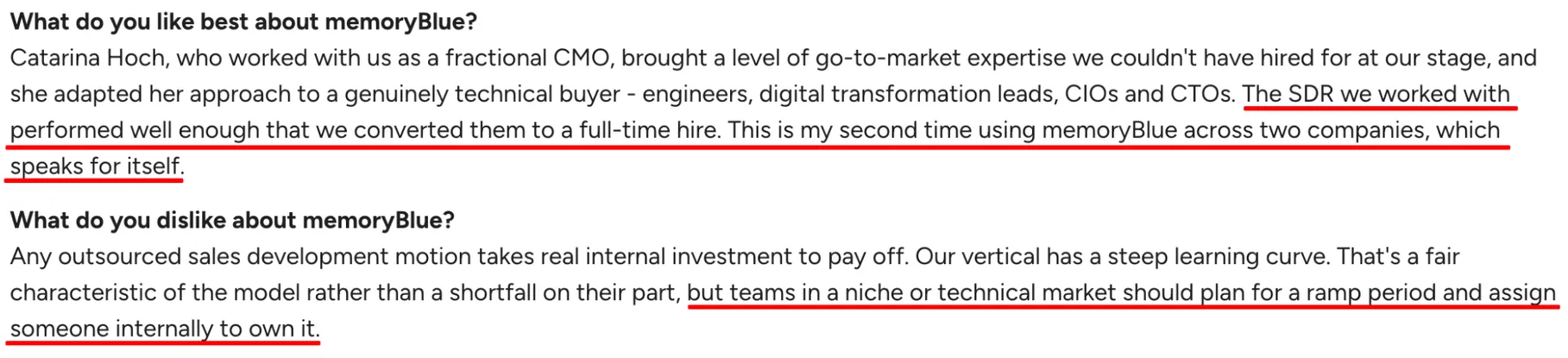
For example, here’s what one of customers had to say about their experience using memoryBlue:
How We Evaluated the Best Outsourced SDR Agencies
To put this list together, we focused on who can support a sales team without creating more work for it:
- Fit with the sales motion: We looked at industry focus, deal complexity, buyer seniority, geography, and whether each model fits SMB, mid-market, or enterprise sales.
- Quality of the SDR operation: We assessed how providers recruit, train, coach, and manage reps, along with the support structure around them.
- Pipeline quality: We gave more weight to qualification, opportunity creation, and pipeline impact than raw meeting volume.
- Ownership of the outbound process: We compared how much each provider handles across targeting, data, messaging, outreach, qualification, and handoff.
- Campaign visibility and optimization: We looked at reporting, CRM integration, call visibility, analytics, and how providers use campaign data to improve targeting and messaging.
- Customer evidence: We reviewed third-party feedback, case studies, and published results, with particular attention to lead quality, ramp time, communication, and rep consistency.
- Pricing and flexibility: We compared pricing models, contract terms, and what is included to understand the balance between cost, control, and expected pipeline value.
Note: memoryBlue publishes this guide and is included in the comparison. We evaluated each provider using the same criteria, including service model, SDR delivery, pricing where publicly available, customer reviews, case studies, and other public information.
10 Best Outsourced SDR Companies to Consider
Here’s a quick side-by-side view of the eleven providers and where each one fits best.
| Company | Best for | Key differentiator | Key strengths | Pricing model |
|---|---|---|---|---|
| memoryBlue | Complex B2B technology sales | Dedicated SDR teams built specifically for technology companies, with the option to hire successful reps in-house | Technical buyer experience, strong coaching, global coverage, 30+ languages, dedicated in-office SDR model, multichannel outbound with Cold Calling being the strongest performer | Custom pricing; fixed-fee, performance-based, and hybrid models |
| Belkins | Managed multichannel appointment setting | Manages the outbound process from prospect research through qualified meeting booking | Manual research, multichannel (email, LinkedIn and calling) strong campaign management, appointment-setting focus | Custom monthly retainers; outsourced SDR programs start around $5,000 |
| SalesRoads | Experienced, phone-led SDR teams | Senior SDR talent backed by dedicated coaching, strategy, and data operations | Experienced reps, strong cold calling, prospect research, hands-on SDR management | Dedicated SDR retainers; starts around $9,950 per four weeks |
| Martal Group | Fractional B2B sales teams | Can extend beyond prospecting into discovery, nurturing, closing, and account support | Experienced sales talent, multichannel outreach, AI-assisted prospecting, broader sales-cycle support | Custom pricing; typically monthly fee plus commission for broader programs |
| CIENCE | AI-supported outbound sales development | Combines managed outbound with its graph8 GTM platform and flexible SDR capacity | AI-assisted targeting, data enrichment, multichannel execution, flexible regional SDR staffing | Setup + monthly strategy/platform fees, with SDR capacity priced separately |
| LevelUp Leads | Flexible full-service SDR support | Fractional, full-service, and growth packages let companies scale the amount of SDR support they outsource | Fast launch, calling capacity, data sourcing, multichannel outreach, campaign management | Starts around $5,000/month; three-month initial commitment |
| Callbox | Global or multilingual outreach | Campaign Pods combine SDRs, data, campaign management, and localized outreach across international markets | 60+ country coverage, multilingual SDRs, multichannel campaigns, strong international infrastructure | Campaign Pod model; roughly $15,000-$30,000/month depending on scope |
| SalesHive | Transparent, flexible US-based SDR outsourcing | Proprietary platform gives clients visibility into calls, recordings, emails, meetings, and campaign performance | US-based SDRs, month-to-month terms, included sales tech and data, strong campaign visibility | Custom flat monthly fee; month-to-month and annual options |
| AltiSales | Building an outbound engine you may later bring in-house. | Its SDR Assembly Line separates prospect research from selling and is designed to build a playbook companies can later bring in-house | Dedicated data specialists, continuous testing, RevOps support, strong process design | Custom pricing for outsourced SDR programs; data and RevOps services priced separately |
| Reveneer | Dedicated, phone-first inside sales teams | Combines dedicated SDR delivery with GTM design, CRM integration, and the option to build the function in-house through Reveneer Flex. | Dedicated reps, phone-led outreach, CRM-native execution, GTM modeling, internal build option. | Custom monthly pricing for Reveneer One and Reveneer Flex |
1. memoryBlue: Best for complex B2B sales
memoryBlue provides outsourced sales development teams for B2B technology and professionals services companies.
It works across SaaS, cybersecurity, data& analytics, AI, networking & communications, cloud, fintech, health tech, managed service providers, digital transformation firms, and other companies selling complex, high-value solutions.
You get dedicated reps that handle prospecting, account research, cold calling, email, LinkedIn, qualification, meeting generation, CRM updates, and campaign reporting.
There’s support for high average deal values, technical buyers, larger buying committees, long sales cycles, ABM programs, and new-market expansion.
Reps work closely with your sales team, with delivery managers and directors providing coaching and quality control.
You have a path to bring proven reps in-house. Through Rising Stars, you can hire SDRs who already know your product, market, and sales motion, instead of recruiting someone new and starting the ramp from scratch. memoryBlue also has a dedicated public sector practice for technology companies selling into government and other public-sector buyers.
Plus, memoryBlue has 650+ sales professionals globally and supports outreach in 30+ languages across North America, EMEA, APAC, and LATAM.
Advantages of working with memoryBlue
- SDRs work as part of your sales team: Reps plug into your CRM, messaging, workflows, and sales process instead of operating as a separate outreach function.
- “What also stands out most is their completely managed service model, which drastically minimizes our internal operational overhead. Instead of us having to recruit, train, and babysit the day-to-day sales pipeline, memoryBlue handles the entire SDR and ISR infrastructure seamlessly.” (Read full review)
- Built for complex B2B sales: memoryBlue works well when you are selling technical products, targeting larger buying committees, or running enterprise outbound programs.
- “Their experience is noticeable, and they understand long sales cycles and getting through gatekeepers. They’re phenomenally transparent, attentive, and communicative, even meeting with us in person, which is pretty rare.” (Read full review)
- Coaching is built into the engagement: SDRs work with managers and directors who provide ongoing coaching, quality control, and campaign optimization.
- “I believe we got very lucky with the SDR and Delivery Manager (who manages our SDR on a day-to-day basis) that we were assigned at the onset of our campaign. Both have proven to be hardworking, coachable, and relentlessly enthusiastic, all of which is important in the world of inside sales.” (Read full review)
- You can expand into new markets without rebuilding from scratch: memoryBlue has 600+ sales professionals globally and supports outreach in 30+ languages across North America, EMEA, APAC, and LATAM.
- “They understood our goals, adapted quickly, and supported us in achieving strong business outcomes. Gary, Kim, and Liri supported our projects in Australia and New Zealand, with many others contributing globally. Everyone we worked with was professional, capable, and committed to helping us succeed.” (Read full review)
The results you get from working with memoryBlue
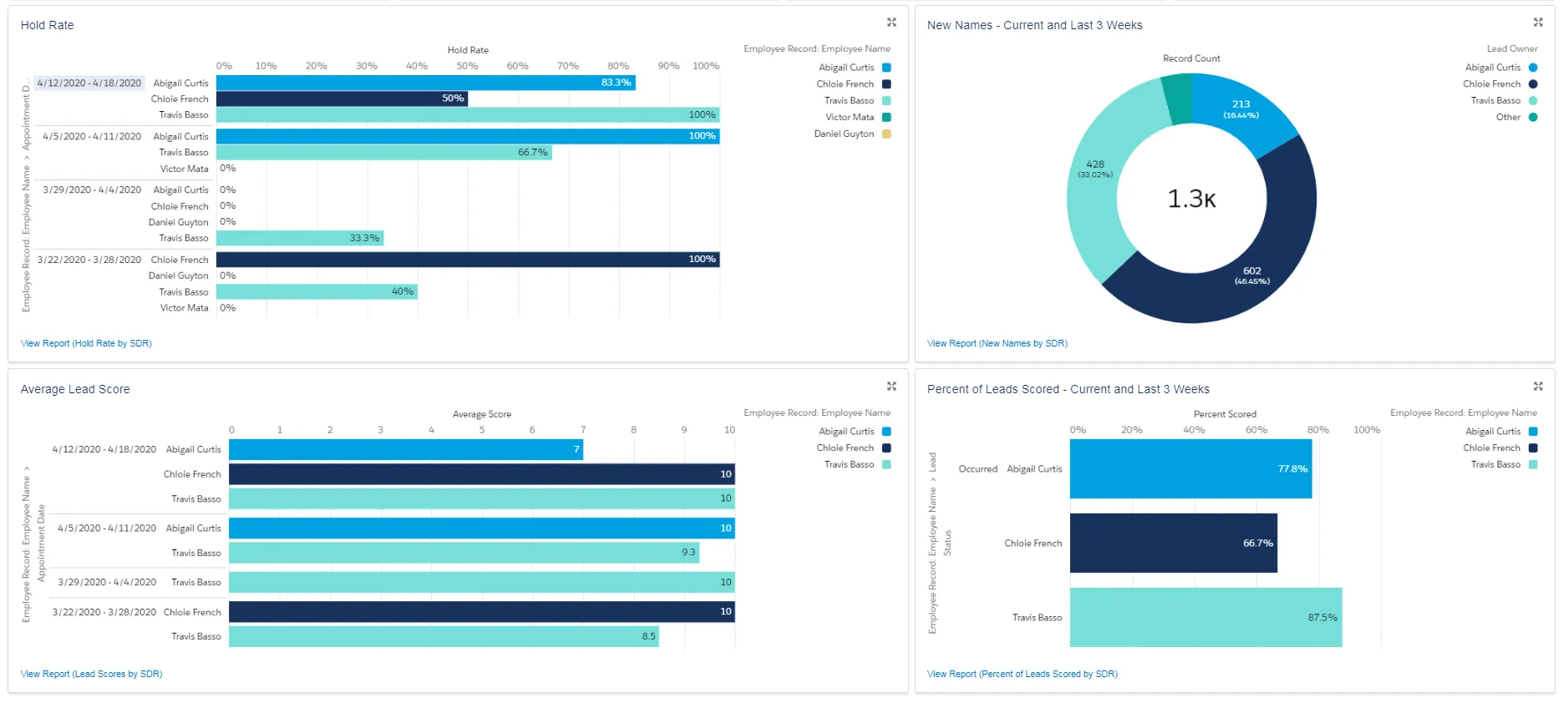
- Qualpay: memoryBlue booked 21 qualified meetings in the first month with a 9.3/10 average lead score. The program generated $244 million in pipeline and contributed to $115 million in closed revenue. By Q4 2024, it was Qualpay’s leading source of closed deals.
memoryBlue understood that our sales team needed highly qualified meetings, not just numbers. Our dedicated SDR, Nick, became a true extension of our team. He proactively qualified leads, handled objections skillfully, and dramatically improved our sales productivity.”
Nick Nottleman, Senior Sales Engineer at Qualpay.
- Gainsight: The North American program generated 530 meetings and more than $500,000 in closed-won business. Gainsight later expanded the partnership into EMEA, where the program reached 170% quota attainment.
“Outsourcing doesn’t mean handing it off and walking away. The memoryBlue team is treated as an extension of Gainsight. They’re part of our enablement, our planning, and our day-to-day execution.”
Craig Downing, VP Marketing, Gainsight.
- Immersive Labs: memoryBlue delivered 140% of the pilot target, with 40% of meetings converting directly into opportunities. Pipeline exceeded expectations by 100%, leading Immersive Labs to double the size of the program.
“I’ve never had a good experience with a lead generation company in my entire career — until memoryBlue. The quality of the meetings, volume of leads, and how the entire process is managed is truly impressive. Everything they produced was detailed, diligent, and exactly what we were looking for.”
Sam Gillon, Head of Sales, Immersive Labs.
When memoryBlue may not be the best fit
memoryBlue may be more than you need if you only want a small number of appointments or a simple pay-per-meeting service.
However, you’ll get better results if your priorities are SDR quality, training, and long-term pipeline development.
Pricing
memoryBlue does not publish a standard dollar price because programs vary by team size, target market, scope, and outbound requirements.
2. Belkins: Best for managed multichannel B2B appointment setting
Belkins is a B2B sales outsourcing and appointment-setting company that manages much of the outbound process for clients.
Its SDR programs cover the full prospecting process. That includes ideal customer profile (ICP) development, manual research, copywriting, cold email, LinkedIn, calling, qualification, and meeting booking.
Belkins can coordinate three or more channels around the same target accounts and use intent data to guide follow-up. And programs can also include sales audits, buyer-profile development, no-show recovery, reporting, and ongoing campaign optimization.
Key strengths
- You can track campaign activity as it happens: Belkins provides ongoing reporting and CRM integrations that show outreach activity and results.
- Researchers validate prospects before outreach: Belkins checks prospect lists against agreed criteria before SDRs begin contacting them.
- Dedicated teams support each campaign: Each engagement is supported by an SDR trained around the client’s market, offer, and sales motion.. There are also strategists, researchers, copywriters, and campaign managers.
Limitations
- Belkins requires a high starting investment: Outsourced SDR programs start at around $5,000, which may make smaller outbound tests less practical.
- Belkins focuses more on appointment generation: The model works best when your sales team can take qualified meetings and move them through the rest of the sales process.
- Most pricing is still customized: The starting point is public, but final costs depend on the market, TAM, sales goals, number of buyer groups, and channel mix.
What customers say about Belkins
- “Their organizational skills shine through the regular, clear reports they provide, showcasing metrics like open rates, replies, and booked meetings, making the process transparent and efficient.” (Read full review)
- “We spent countless hours editing and correcting emails written by them that were filled with errors, disconnected logic and misinformation.” (Read full review)
Pricing
Belkins starts at $5,000/month for both appointment setting and outsourced SDR services. You get 1,500 leads per month, three outreach channels, and 100+ meetings per year.
3. SalesRoads: Best for experienced, phone-led SDR teams
Similar to Belkins, SalesRoads provides fully managed outsourced SDR and appointment-setting programs with dedicated reps.
You also get an SDR, client strategist, SDR performance coach, optimization specialist, and research & data team. For the set up, there’s prospect data (using 14+ sources), CRM integration, reporting, and a custom demand-generation playbook.
Key strengths
- Experienced SDR talent: SDRs average 5-10 years of sales experience, which helps with complex calls, objection handling, and buyer conversations.
- Phone coaching is built into the program: Performance coaches review calls, refine talk tracks, and improve targeting and execution.
- Flexible outbound programs: Teams can use SalesRoads for appointment setting or market-research lead generation, depending on the goal.
Limitations
- The starting price is high: A dedicated SDR starts at $9,950 per four weeks, which can be too high for smaller tests.
- Complex CRM setups may need extra planning: Teams with custom Salesforce workflows or unusual data requirements should confirm how information will move between systems before launch.
- Reporting feels fragmented for some teams: Teams that want one consolidated view of activity, pipeline, and performance often need additional reporting setup.
What customers say about SalesRoads
- “Some of their methods and procedures are old school, but they delivered great results.” (Read full review)
- “Costly for small businesses or startups especially considering the tailored pricing model.” (Read full review)
Pricing
SalesRoads uses a four-week retainer model. The current Growth package starts at $9,950 per four weeks for one dedicated SDR, while two SDRs cost $16,750 and three cost $23,500 per four weeks.
4. Martal Group: Best for fractional B2B sales teams
Martal Group provides outsourced B2B lead generation and sales services through fractional SDR and sales teams.
Campaigns combine phone, email, and LinkedIn. Its AI SDR platform supports prospect research, enrichment, personalization, intent signals, and campaign optimization.
Key strengths
- Fractional sales capacity without building the function internally: Martal can provide Sales Executives plus research, campaign, and operations support around the engagement.
- AI-supported prospecting and targeting: Martal uses a database of more than 220 million contacts and 10 million+ intent signals to help prioritize accounts, enrich data, and support personalized outreach.
- Can support more of the sales cycle: Martal’s higher service tiers can extend beyond initial prospecting into discovery, sales support, and account management, which is useful for companies that need broader fractional sales capacity.
Limitations
- The fractional model may not fit every team: Companies that want one fully embedded SDR working exclusively inside their organization may prefer a dedicated-SDR provider.
- The pilot requires a longer commitment: Martal starts with a four-month pilot before moving to a monthly subscription.
- Narrow markets can limit scale: Highly specialized segments may run through viable prospects faster and produce less consistent pipeline.
What customers say about MartalGroup
- “Weekly syncs where we’re direct about what’s working and what isn’t, then we move. They adjust fast and double down harder.” (Read full review)
- “The primary challenge was achieving the depth of market penetration we required for our most specialized niche segments.” (Read full review)
Pricing
Martal uses a flat monthly fee plus sales commission for its fractional sales programs and currently lists a four-month pilot before moving to a monthly subscription.
5. CIENCE: Best for AI-supported outbound sales development
CIENCE combines managed sales development with graph8, its AI-powered GTM platform.
The service covers campaign setup, prospect data, intent-based targeting, outreach, qualification, and ongoing optimization across email, phone, LinkedIn, and digital channels.
graph8 powers the data, enrichment, visitor intelligence, automation, and campaign orchestration behind the program.
Key strengths
- Flexible SDR capacity: Companies can add offshore, European, or US-based SDRs at different experience levels and adjust capacity as campaigns change.
- CIENCE builds the outbound foundation first: The setup sprint covers targeting, data, campaigns, and infrastructure before outreach scales.
- Strong multichannel coverage: CIENCE can coordinate email, phone, LinkedIn, visitor targeting, and intent-driven campaigns through one system.
Limitations
- The model can feel complex: Companies pay for the GTM setup, strategic support, graph8, and SDR capacity separately, which adds more moving parts than a simple SDR retainer.
- Costs rise as you add SDRs: The base service covers the platform and strategic team, while additional SDR capacity increases the total spend.
- Account continuity has been an issue for some clients: Changes in campaign ownership can slow momentum when the team needs deep product or market knowledge.
What customers say about CIENCE
- “The hands on approach. They wanted me to be successful so I will continue working with them. They also communicate incredibly well and have been incredibly responsive.” (Read full review)
- “We churned through 4 different campaign managers, so we never got our footing in the actual campaign.” (Read full review)
Pricing
CIENCE’s current managed SDR offering starts with a one-time GTM setup of $5,000, a $2,000/month strategic team, and graph8 at $499/month, with additional SDR capacity quoted separately
6. LevelUp Leads: Best for flexible full-service SDR support
LevelUp Leads is flexible sales development across prospect research, list building, cold calling, email, LinkedIn, appointment setting, and campaign management.
Its Fractional SDR, Full-Service SDR, and Growth packages let companies choose how much of the SDR function they want to outsource.
Key strengths
- Most of the outbound setup is included: LevelUp Leads can handle prospect data, copywriting, SDR execution, sales technology, campaign management, and reporting.
- Clear campaign visibility: The reporting dashboard includes campaign metrics, meeting tracking, contact activity, and call recordings.
- Fast launch: Campaigns typically go live within 7-10 days, and onboarding is not billed.
Limitations
- Your internal sales team still has to close: LevelUp Leads focuses on top-of-funnel execution and hands qualified meetings to the client.
- Reporting may not go deep enough for every team: Overall dial and conversation totals are visible, but teams have less granular reporting on parallel-dialing activity by account.
- The initial commitment is three months: After that, engagements move to month-to-month service.
What customers say about LevelUp Leads
- “I’m impressed with how quickly they’ve implemented their strategy and adapted when adjustments were needed.” (Read full review)
- “They are a small team, so while they are nimble and effective, it may be tough to escalate an urgent issue.” (Read full review)
Pricing
LevelUp Leads starts at $5,000 per month with a 3-month commitment. But this is only a starting estimate as full cost depends on SDR capacity, outreach volume, data requirements, and the level of campaign support included.
7. Callbox: Best for global or multilingual outreach
Callbox offers outsourced SDR, appointment-setting, ABM, data, and lead-generation services. It combines dedicated reps with data research, campaign management, account strategy, and client success support.
The main advantage is its international coverage. Callbox operates across 60+ countries and supports campaigns in North America, EMEA, APAC, and LATAM.
Teams can also use native-language agents and regional playbooks, while phone, email, and LinkedIn outreach run through its Pipeline platform.
Key strengths
- Dedicated campaign pods: Each program includes an SDR, campaign manager, research and data support, and digital marketing resources.
- Centralized multichannel outreach: Smart Engage coordinates phone, email, LinkedIn, and digital touches in one sequence.
- AI-supported targeting: Callbox uses AI for outbound prospecting, enrichment, personalization, sequencing, and analytics, while SDRs handle lead qualification and sales conversations.
Limitations
- Performance varies by region: International campaigns need more localization around messaging, targeting, and market-specific buying behavior.
- The commitment is relatively high: Callbox typically costs $20,000-$40,000 per quarter, which may be too much for teams that only need limited calling support.
- Data coverage can vary by market: Prospect data is stronger in some regions than others, so teams should validate coverage before expanding internationally.
What customers say about Callbox
- “A call centre in the UK/US with people who know the local rules and customs of the target audience could help customers understand what they want and talk to them better.” (Read full review)
- “Their detailed reporting and constant communication ensured we stayed aligned throughout the campaigns.” (Read full review)
Pricing
Callbox uses a campaign pod. One pod is around $15,000-$30,000 per month. The price includes a dedicated SDR, multichannel outreach, AI-enriched data, campaign management, and weekly reporting.
8. SalesHive: Best for transparent, flexible US-based SDR outsourcing
SalesHive also offers outsourced SDR support across prospect research, list building, cold calling, email, qualification, and appointment setting.
Each program combines SDRs with a dedicated sales strategist and SalesHive’s own platform. That includes its Power Dialer, eMod personalization, Smart Inbox, list-building tools, analytics, and CRM sync.
Key strengths
- Strong campaign visibility: SalesHive gives you access to calls, emails, recordings, meetings, and campaign performance, with CRM sync back into your existing system.
- Flexible contract structure: Full-service programs run month to month with no setup fee or long-term commitment.
- US-based calling is a core option: SalesHive trains US-based SDRs in objection handling, qualification, and B2B calling before they work client campaigns. There’s also an offshore option for teams with limited budgets.
Limitations
- The proprietary platform limits workflow flexibility: Teams that want SDRs working entirely inside their existing tools should confirm how deeply SalesHive can adapt to their stack.
- Delivery can include offshore SDRs: Companies that specifically want US-based representation should make that requirement clear when defining the engagement.
- Rep changes can disrupt momentum: SDR turnover or reassignment can slow outreach, especially when the rep has already built product and market knowledge.
What customers say about SalesHive
- “They were not experts, did not respond to feedback, and were litigious when presented with facts.” (Read full review)
- “SalesHive has a solid technology stack and a structured approach to outbound campaigns.” (Read full review)
Pricing
SalesHive uses custom flat monthly pricing based on the team model, channel mix, and outreach volume.
9. AltiSales: Best for building an outbound SDR engine you can later bring in-house
AltiSales combines outsourced SDR support with GTM consulting via its ‘SDR Assembly Line.’ Data researchers build and enrich account lists, while dedicated SDRs focus on calls, email, LinkedIn, qualification, and meeting booking.
AltiSales also uses campaign data to refine targeting, buyer personas, messaging, and meeting quality over time.
Key strengths
- Uses campaign data to refine performance: AltiSales reviews calls, messaging, personas, sequences, and targeting to improve what converts.
- Supports existing SDR teams: Companies can add RevOps, data operations, hiring, coaching, and account distribution without outsourcing the entire function.
- Makes it easier to build an in-house sales team: Clients can transfer the workflows, methodology, and supporting IP into their own team once the motion is proven.
Limitations
- The model can be broader than necessary: Teams that only need a caller or pay-per-meeting service may not need the added consulting, RevOps, and process design.
- The cost may be high for early-stage teams: The combination of consulting, infrastructure, and execution can require a larger budget than lighter SDR services.
- The focus is mainly on pipeline generation: AltiSales helps build and improve qualified pipeline but does not manage the full sales cycle through closing.
What customers say about AltiSales
- “Their team brought both strategic guidance and hands-on execution, which made it easier for us to test messaging, improve our sequences, and create a more repeatable process for generating qualified meetings.” (Read full review)
- “They’re not a full-fledged sales agency per se at helping improve close rates. They’re just very good at producing recurring meetings and recurring pipeline for the sales team.” (Read full review)
Pricing
AltiSales uses custom pricing for its main outsourced SDR and GTM Acceleration programs.
10. Reveneer: Best for dedicated, phone-first inside sales teams
Reveneer runs managed inside sales through Reveneer One. It recruits, trains, manages, and equips a dedicated SDR team that works inside your CRM.
The model is strongly phone-first, with AI-assisted account research, prospect data, email, and LinkedIn supporting the calling motion.
For companies that want to bring the function in-house, Reveneer Flex helps design the process, choose the tech stack, recruit and train SDRs, and launch the internal team.
Key strengths
- Dedicated SDR teams: Reveneer assigns reps to your program and trains them around your market, messaging, and sales process.
- Strong phone-first motion: Calling leads the outreach strategy, with email and LinkedIn supporting the conversation.
- Useful for testing new GTM motions: Reveneer models market potential, ramp time, and cost per opportunity before launch, then prioritizes accounts through its PerfectFit process.
Limitations
- The model is built for dedicated teams: Companies that only need a small amount of SDR support may find a fractional provider more practical.
- Launch takes time: Reveneer One typically takes around 45 days to launch, while Reveneer Flex takes about 60 days.
- The phone-first approach will not fit every market: Companies that rely more on product-led, partner, community, or inbound motions should make sure calling matches how their buyers engage.
Pricing
Reveneer does not disclose its pricing.
Outsourced SDR Pricing and Engagement Models
At this point, the shortlist usually comes down to what you need the partner to solve.
- Choose memoryBlue if the sale itself is complex: It’s great for B2B technology companies where SDRs need to understand technical buyers, longer sales cycles, and more complex qualification before handing opportunities to AEs.
- Choose Belkins if your main goal is consistent appointment generation: Its model is a better fit when you mainly want a provider to take ownership of prospecting and consistently turn that outreach into qualified meetings.
- Choose Callbox if geography is the challenge: Companies prospecting across several regions or languages may get more value from its international delivery infrastructure than from a provider built primarily around one market.
- Choose AltiSales if you are still figuring out the outbound motion itself: It is particularly relevant when the goal is not only to add SDR capacity, but also to improve targeting, messaging, process, and the system you may eventually run internally.
How to Choose the Right Outsourced SDR Company for Your Needs
Outsourced SDR pricing is difficult to compare because providers are not always selling the same thing.
One quote may cover a dedicated SDR plus management, data, and technology, while another is mainly tied to meetings delivered.
So a useful way to compare them is by how you are paying for the sales capacity and who carries the performance risk.
| Engagement model | How it works | When to consider | What to watch |
|---|---|---|---|
| Dedicated SDR retainer | You pay a recurring fee for one or more dedicated SDRs, usually with management and supporting resources included. | When you need consistent outbound capacity and want reps to learn your product and market over time. | Check what sits behind the SDR. Data, tools, coaching, management, and reporting may or may not be included. |
| Fractional SDR | You buy a portion of an SDR or sales team’s capacity rather than a full-time resource. | Useful for testing outbound, entering a new market, or adding capacity without funding a full team. | Clarify how much rep time you actually receive and whether the same SDR is shared across several accounts. |
| Pay per appointment | Fees are tied to meetings booked or held rather than SDR headcount. | Attractive when you want to limit fixed costs or test demand before making a larger commitment. | Define “qualified” carefully. Otherwise, the incentive can shift toward meeting volume rather than opportunities your AEs want. |
| Hybrid pricing | A smaller fixed fee covers the team and infrastructure, with additional fees tied to meetings, opportunities, or another agreed result. | Useful when you want dedicated support while keeping some compensation tied to performance. | Understand exactly which outcomes trigger additional fees and how no-shows, rejected meetings, and qualification disputes are handled. |
Predictable Pipeline Starts With the Right SDR Partner
Outsourcing sales development works best when the partner does more than fill calendars.
You want a team that understands your market, knows how to speak to your buyers, and can turn outbound activity into opportunities your sales team actually wants to pursue.
That is why the right choice depends on the kind of sales motion you are trying to build. Some providers are better for appointment setting, others for international coverage, and others for testing a new outbound model.
For complex B2B technology sales, memoryBlue stands out because it combines dedicated SDR teams, strong sales coaching, global coverage, and the option to bring proven reps in-house later.
That gives you a way to add outbound capacity now without treating outsourcing as a permanent black box.
If you are looking for an SDR partner that can work closely with your team and help build a more reliable pipeline over time, memoryBlue is a strong place to start.
See what a dedicated memoryBlue SDR team could look like for your business →
Let’s build your pipeline, together
Success in sales takes more than just leads—it takes the right strategy, smart outreach, relentless execution and a powerful team. Partner with memoryBlue to build pipeline, nurture prospects and drive revenue.
FAQs
Thinking about outsourcing your sales team? Here’s what you need to know.
How much does it cost to outsource SDRs?
There is no standard price for SDR outsourcing services. Costs depend on whether you hire a dedicated SDR, use a fractional team, pay per meeting, or choose a hybrid model.
Prices can start around $4,000 per month on the low end, and range all the way up to $25,000+ per month at the enterprise level.
It’s best practice to scope out the full engagement, including data, tools, management, SDR capacity, and setup fees, rather than the monthly retainer alone.
Is it better to outsource SDRs or hire in-house?
It depends on what you are trying to achieve. An internal team gives you more direct control, but you also take on recruiting, training, management, and the sales technology needed to support it.
SDR as a service can also work when you need to launch quickly, test new markets, or add capacity without another hiring cycle.
Some companies use both, keeping a core internal team while outsourcing specific markets or sales strategies.
What should outsourced SDR services include?
At a minimum, the provider should be able to handle prospect targeting, data sourcing, outreach, qualification, meeting booking, and reporting.
More complete sales outsourcing services may also include SDR management, messaging, sales tools, CRM integration, call recordings, and campaign optimization.
The exact scope is important here because some providers offer a full SDR function while others are closer to appointment-setting services.
What counts as a qualified SDR meeting?
A qualified meeting is one that matches the criteria your sales team agreed on before outreach starts.
That might include account fit, buyer role, relevant need, and genuine interest in continuing the conversation. The definition should be clear enough that both the SDR or BDR and your account executives know which meetings are actually worth progressing.
Can an outsourced SDR team work inside our CRM?
Yes. Most established providers can work with CRMs such as HubSpot or Salesforce and pass outreach activity, prospect details, qualification notes, and meeting information back to your internal team.
Are outsourced SDR companies the same as AI SDR platforms?
No. Most companies in this guide provide human SDR teams, although many now use AI for research, personalization, data enrichment, and campaign optimization.
AI SDR software takes a more automated approach to prospecting and outreach. The better fit depends on how much of the sales conversation requires human judgment, product knowledge, and objection handling.
Get in touch
Ready to Build More Pipeline?
Tell us where opportunities are stalling and what “qualified” means in your sales process. We’ll show you what a dedicated program built around your business actually looks like.