

memoryBlue and Alleyoop both help B2B companies book qualified meetings without building an outbound team in-house. Each one supplies dedicated reps and the sales technology to support them.
A booked meeting is just the first step, though. According to Ebsta and Pavilion’s 2025 GTM Benchmarks, new-business deals take an average of 91 days to close.
That leaves a lot of work after the first call, from deeper discovery to bringing other decision-makers into the deal. Someone has to own it, and each provider handles that part differently.
Alleyoop focuses on the meeting itself, and your AEs take each deal from there. memoryBlue can stay involved for the rest of the cycle, qualifying and progressing deals until they’re ready to close.
Below you’ll find a side-by-side look at the key differences, each provider’s pricing, and what users say on G2.
How do memoryBlue and Alleyoop compare?
| Evaluation criteria | memoryBlue | Alleyoop | Ideal fit |
| Service scope | SDR, ADR, and AE services cover the deal from first outreach to close | Appointment setting up to the booked meeting, with your AEs taking over from there | memoryBlue, for support after the first meeting |
| SDR training and management | 12-step hiring, six-week Academy, and daily in-person coaching | A week of paid training, ongoing coaching from team leads | memoryBlue, for technical products and senior buyers |
| Account targeting and buying signals | Intent data, AI-assisted research, and call insights shape account priorities | PlayIQ scores every account on market signals | Depends. memoryBlue for complex buying groups, Alleyoop for a packaged scoring model |
| Marketing and outbound outreach | Phone-led outreach, with separate marketing services and mB Grow for broader campaigns | Digital warm-up in every program, with content production as a paid add-on | Depends. memoryBlue for long-cycle nurturing, Alleyoop for a built-in warm-up |
| Lead qualification and opportunity development | Meetings scored against your framework, then ADRs develop each opportunity | Meetings count once your team accepts them | memoryBlue, for qualified pipeline |
| Industry expertise and global reach | Technical B2B and public-sector focus, with outreach in 30+ languages | 49 listed industries, covered by onshore reps in the US | memoryBlue, for technical sales and international expansion |
| Reporting and campaign optimization | Live portal with lead scores, weekly to quarterly reviews, and program benchmarks | Live dashboard, call recordings, and a weekly program call | memoryBlue, for insight into pipeline quality |
| Long-term value and handoff | Audition-to-hire model, with account history kept in your CRM | High IQ Exit transfers the campaign’s data and assets | Depends. memoryBlue for building an in-house team, Alleyoop for keeping campaign assets |
What are the key differences between memoryBlue and Alleyoop?
Service scope
Both providers book qualified meetings, but Alleyoop’s work ends there. memoryBlue also offers services for everything that comes after the meeting.
memoryBlue
memoryBlue’s sales services cover the full deal cycle, from first outreach to a signed contract.
- SDRs handle prospecting and book qualified meetings.
- ADRs pick up after the first meeting and develop it into a sales-ready opportunity.
- AEs take opportunities through to a signed deal and can also handle expansion with existing customers.
You can buy these services together or one at a time. A team short on closers might start with AEs alone, while one with plenty of meetings but few qualified opportunities might add ADRs first.
Alleyoop
Alleyoop’s programs cover what they call the first half of the sales cycle, from list building to the booked meeting. Dedicated onshore reps, called Playmakers, prospect and book qualified meetings, then brief your AE on each account.
Whatever happens after that first conversation depends on your in-house sales team.
Verdict → memoryBlue fits companies whose deals stall after the first meeting, or whose AEs have no room for more early-stage calls. Alleyoop fits teams with AEs who have time to qualify and close, and who mainly need more meetings on the calendar.
SDR training and management
memoryBlue runs a formal hiring, training, and in-office management system. Alleyoop keeps onboarding short and builds rep skills through day-to-day coaching.
memoryBlue
Before a memoryBlue rep calls anyone on your list, they’ve passed a 12-step hiring process that includes personality assessments and multiple interviews. Several hiring managers sign off on each candidate, and every hire completes the six-week Academy, even those with prior sales experience.
Once your program starts, a Delivery Manager coaches your reps in person every day. Weekly sessions with AI role-plays keep that coaching focused on your product and market. A Managing Director oversees the account, and if a rep underperforms, memoryBlue brings in an Academy-trained replacement.
Alleyoop
Most of Alleyoop’s rep development happens on the job. After a week of paid training, Playmakers work remotely within the US and get ongoing coaching from team leads.
Alleyoop transcribes and scores every call automatically, and team leads use those scores to guide their feedback.
Verdict → In tech sales, where buyers are often senior or technical, memoryBlue’s longer training and daily in-person coaching give reps more time to learn your product. Alleyoop’s lighter model works well for teams with proven messaging that prefer weekly check-ins.
Account targeting and buying signals
Each provider uses buying signals to choose which accounts to contact first. Alleyoop scores every account in your market through PlayIQ, and memoryBlue adds AI-assisted research and live call insights to its intent data.
memoryBlue
memoryBlue SDRs start from your ICP and rank accounts by signals such as funding rounds and leadership changes. Before each call, AI-assisted research adds account and persona context, and reps map the buying group so outreach covers several stakeholders.
Calls also generate signals of their own. Conversation intelligence captures objections and competitor mentions across the program, and memoryBlue feeds those patterns back into targeting and messaging.
Alleyoop
Alleyoop’s PlayIQ system scores accounts continuously on a wide range of buying signals. Accounts showing stronger interest move up the priority list, and Playmakers get the context behind each signal before they make contact.
Verdict → Alleyoop offers a packaged scoring model that clients keep when the program ends. memoryBlue is the better choice for complex sales with large buying groups, since its targeting adapts to what reps hear on calls.
Marketing and outbound outreach
Alleyoop includes demand generation in its appointment-setting programs, while memoryBlue treats it as a separate service for longer-term campaigns.
memoryBlue
memoryBlue SDRs run multichannel outreach and can follow up on leads from a client’s own marketing campaigns.
For broader campaigns, memoryBlue’s separate marketing services cover account-based campaigns, content, and webinars. Its mB Grow program combines the two, with marketing campaigns warming prospects before SDRs reach out.
Alleyoop
Alleyoop combines digital outreach with its Playmakers’ calls. Cold email and LinkedIn campaigns help engage target accounts before reps contact prospects and work toward qualified meetings.
Its appointment-setting packages include this digital outreach, but additional content production comes at an extra cost. Alleyoop’s Showtime service turns interviews with client experts into short videos, social posts, and newsletters that can support the campaign.
Verdict → Every Alleyoop program comes with a digital warm-up. memoryBlue gives teams more say over how marketing supports outreach, such as webinars for strategic accounts that need months of nurturing.
Lead qualification and opportunity development
Alleyoop counts a meeting only when your team accepts it. memoryBlue has your AEs score every meeting, and its ADRs can keep qualifying the opportunity after that first call.
memoryBlue
Before an SDR books a meeting, memoryBlue scores the conversation against the client’s agreed qualification framework. Clients can then rate each lead on a scale of 1–10, and memoryBlue’s managers use those scores to track meeting quality.
For opportunities that need more work, ADRs can run further discovery using BANT, MEDDIC, or your own framework. They also keep slower deals moving and bring in other stakeholders before handing each opportunity to an AE.
Alleyoop
Each meeting has to match your ICP and the qualification criteria agreed before launch. Alleyoop grades its programs on accepted meetings and tracks each one through to deal creation and win.
Verdict → For a defined meeting count, Alleyoop’s written standard does the job. memoryBlue is the better choice when the goal is a sales-ready pipeline.
Industry expertise and global reach
memoryBlue pairs tech sales expertise with native-language outreach on three continents. Alleyoop covers 49 industries through US-based reps.
memoryBlue
memoryBlue specializes in technical B2B markets such as cybersecurity, AI, fintech, and data analytics, with hundreds of active programs in its core verticals. For public-sector sales, its B2G service trains reps on government procurement cycles and compliance frameworks.
Teams in the US, UK, and Singapore support outreach in 30+ languages, delivered by native or fluent speakers. Companies expanding into France, Germany, or the Nordics can launch several regions at once, before opening a local office or hiring.
Alleyoop
Alleyoop lists programs for 49 industries, and more than 20 are commercial trades like HVAC and roofing that sell to local facility managers. B2B SaaS, technology, and financial services are on the list too.
Those markets are mostly domestic, and Alleyoop staffs them the same way, with onshore reps. Companies selling into other regions or languages should confirm coverage with Alleyoop directly.
Verdict → Alleyoop suits US-focused companies in a broad mix of industries. When the product is technical, the buyer is a government agency, or the next market is overseas, memoryBlue is the better-equipped partner.
Reporting and campaign optimization
Alleyoop’s reporting centers on activity, meetings, and call visibility, while memoryBlue adds lead quality scores, ROI, and benchmarks from other programs.
memoryBlue
memoryBlue’s live client portal shows activity and conversion rates next to a quality score for every lead. A week with plenty of meetings but low scores flags a targeting problem early, before those leads clog your AEs’ calendars.
Your Delivery Manager goes through call breakdowns and next week’s forecast with you every week. Monthly and quarterly reviews go deeper, comparing ROI and lead scores with memoryBlue’s benchmarks from similar programs and agreeing on changes to targeting or messaging.
Alleyoop
Alleyoop’s live dashboard tracks activity and booked meetings and sends an alert when a new lead comes in. Clients can also listen to recorded calls and check buying-group maps to see which stakeholders are involved in each account.
A weekly call with the program lead covers results and the next week’s plan. Enterprise clients can add a Campaign Director and set the reporting cadence around their own QBRs.
Verdict → Alleyoop keeps teams current on activity, new leads, and the conversations behind them. memoryBlue gives a clearer read on pipeline quality and what needs to change.
Long-term value and handoff
You keep your campaign data with either provider. With memoryBlue, hiring the reps who worked your account is also an option for each engagement.
memoryBlue
Every memoryBlue SDR works with a single client account, so over the course of a program they learn the product, the buyers, and the objections that come up on calls. Under the audition-to-hire model, clients can bring that rep onto their own payroll once they’ve seen the results.
More than 1,000 SDRs have moved to client teams this way. For companies that struggle to recruit and train sales staff, it’s a way to start an in-house SDR team with someone already up to speed.
Account history stays with you too. When a program runs inside your own CRM, every call, email, and meeting the rep logged remains in your system after the engagement ends.
Alleyoop
Alleyoop handles the end of an engagement through its High IQ Exit, which gives clients the assets their campaign built. That covers the trained scoring model, the playbook, and the data behind them, so a client that later builds its own team or changes provider doesn’t start from zero.
Verdict → Alleyoop suits companies that expect to keep outsourcing and want a complete asset handover if they leave. memoryBlue is the stronger choice for building an in-house team, since hiring your reps is a standard part of every engagement.
How do memoryBlue and Alleyoop compare in terms of pricing?
Alleyoop has fixed six-month packages, while memoryBlue prices each program based on its scope and goals.
memoryBlue
memoryBlue’s pricing is custom, so the final number depends on team size, markets, and services. You can choose from three models:
- Performance-based: A lower base fee plus a fee for each meeting delivered.
- Standard retainer: A fixed monthly fee for SDR programs that can track progress across the pipeline, from account engagement through qualified opportunities.
- Hybrid: Combines fixed monthly pricing with performance-based fees.
All three pricing models use the same dedicated SDR team and management, and the roughly two-week onboarding period is not billed.
Alleyoop
Alleyoop sells three programs on six-month terms, each at a flat monthly fee that doesn’t change with the number of meetings:
- Lift: $5,250 a month for one rep ($31,500 over six months)
- Grow: $10,000 a month for two reps ($60,000 over six months)
- Scale: $14,750 a month for three reps ($88,500 over six months)
Each package includes PlayIQ. Their website visitor identification costs an extra $500 a month, and Showtime adds $2,750 a month.
| Keep this in mind when comparing prices → Monthly price and cost per opportunity are not always the same thing. An $8,000 program that delivers four opportunities costs $2,000 each, while a $12,000 program with eight brings that down to $1,500. For complex enterprise sales, the extra work after the first meeting can justify a larger monthly budget. |
Verdict → Alleyoop’s prices are easy to check upfront, since every package is listed online. memoryBlue gives you more say in how you pay, whether that’s per meeting or a monthly retainer that covers deeper qualification.
User reviews and customer feedback
Both companies have good G2 ratings. memoryBlue has 4.6 out of 5 from 349 reviews, and Alleyoop has 4.9 from five.
memoryBlue
For one G2 user, memoryBlue’s training and multichannel follow-up led to an 85% attendance rate on scheduled calls:
“I really like memoryBlue’s methodologies and expertise. They have an incredibly high show rate for meetings, with 85% attendance on scheduled calls. Their expertise doesn’t just mean hiring talented people, but also creating a great sales culture and training.
The combination of social, email, and phone follow-ups, especially through LinkedIn, enhanced our outreach and engagement success.”
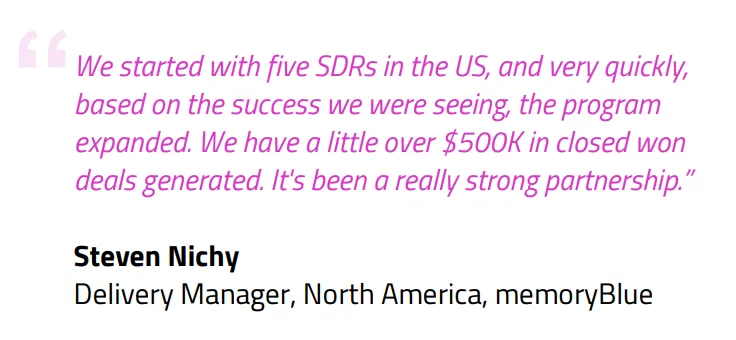
Gainsight saw that training pay off when it brought memoryBlue in alongside its internal SDR team. The company expected a heavy onboarding lift, but memoryBlue’s reps came in with core SDR skills in place, so Gainsight only had to add product and industry context.
Alleyoop
Patience and speed both come up in Alleyoop’s reviews, a helpful combination for teams whose go-to-market date keeps shifting. As one G2 user explained:
“The entire team at Alleyoop has been extremely easy to work with. They were very patient with us as we moved through our product development cycle, and when we were ready, they got a campaign up and running very quickly.”
Another G2 user mentions Alleyoop’s approach to LinkedIn content:
“They seem to have a really good process for creating content for LinkedIn, which we might leverage in the future.”
The Right Partner Should Deliver More Than Meetings
Alleyoop gives B2B teams a clear way to get qualified meetings on the calendar, with published pricing, account scoring, and a digital warm-up built into every program.
For many buyers, what’s more important is how many of those meetings turn into qualified opportunities, and who does the work to get them there.
memoryBlue tracks both sides of that equation. In a single year, its programs created more than $2 billion in pipeline for clients, and client sales teams rated its meetings 7.8 out of 10 on average.
It all comes down to how far you want an outside team to take your deals.
- Go with Alleyoop if you mainly need qualified appointments and prefer a packaged program with set monthly pricing.
- Go with memoryBlue if you want a partner that can grow with your pipeline needs.
Every sales team needs a different mix of support, and memoryBlue can scope a program around yours. Book a strategy call to discuss your target markets and pipeline goals.
FAQs
Can memoryBlue and Alleyoop work with our existing prospect data?
Yes. memoryBlue can work with your existing lead lists or build new ones, and campaigns can run inside your own CRM. Alleyoop builds its target list through PlayIQ and adds leads to your CRM, so ask how it would combine that list with the data you already have.
What happens when target accounts aren’t showing active buying signals?
memoryBlue reps can still open conversations with strategic accounts through cold calling, even before those accounts show any signals. Alleyoop keeps those accounts under watch and warms them with digital outreach until they show interest. If your market has little existing demand, direct outreach will have a bigger impact.
Can memoryBlue and Alleyoop support inbound leads that need more than a booked meeting?
memoryBlue can take on inbound leads as well as outbound ones, and keep working them until they’re ready to close. Alleyoop’s programs focus mainly on outbound appointment setting.
How quickly can each provider book a first meeting?
On average, memoryBlue books the first meeting in about 15 days. Alleyoop programs need up to 30 days to launch, and the first qualified meetings usually come in weeks three or four.
Should we consider other providers when comparing memoryBlue and Alleyoop?
If you’re still deciding, Belkins, Martal Group, CIENCE, and SalesRoads are other outsourced sales development providers worth a look. Each one handles the sales process a little differently, so ask what happens after the first meeting.