



DemandZEN and memoryBlue provide outsourced sales development for B2B companies, and both offer dedicated reps and a pricing option tied to meetings. From there, though, each staffs, manages, and measures its programs differently.
At the most basic level:
- memoryBlue provides a managed sales development team that works as part of yours and can grow into a wider sales function over time.
- DemandZEN provides an experienced outbound team that specializes in booking qualified meetings for your AEs.
Below, you’ll see how they compare in six key areas, along with what customers have said about each provider.
How Do DemandZEN and memoryBlue Compare?
| Criteria | memoryBlue | DemandZEN | Best fit |
| Core service focus | Managed sales development, from first meetings through to closing | Appointment setting for US buyers, with performance-based options | DemandZEN for a meeting-focused program. memoryBlue for a broader SDR function |
| Pricing and engagement models | Performance-based, capped retainer or hybrid; non-billable setup period | Pay per held meeting with an onboarding fee, or dedicated BDRs on Demand FTE | DemandZEN for per-meeting pricing with a shortfall refund. memoryBlue for a choice of models. |
| SDR experience and training | 12-step hiring, six-week Academy and weekly coaching for every rep | Tenured, US-based BDRs with 2–10+ years of experience | DemandZEN for prior experience. memoryBlue for consistent training |
| Meeting qualification and QA | Agreed framework, scored conversations, AE meeting scores, hold-rate tracking | Dedicated QA team approves each meeting against client criteria | DemandZEN for pre-approval. memoryBlue for client-side scoring |
| Prospect data and research | Multiple data and intent partners, account research, conversation intelligence | Up to 12 data sources, data specialists, mobile-number enrichment | memoryBlue for account targeting. DemandZEN for phone-ready contact data |
| SDR staffing and management | Reps dedicated to one client, with a Delivery Manager and Managing Director | Client Success Manager, with dedicated BDRs on Demand FTE | memoryBlue, since every plan includes reps dedicated to your account |
| Reporting and accountability | Live portal, weekly to quarterly reviews, benchmarks, pipeline and ROI | CSM-led reviews every one or two weeks; meeting-focused reporting | memoryBlue, for deeper performance insights than DemandZEN’s meeting-focused reporting |
| Geographic coverage and languages | Seven offices, 30+ native languages, North America, EMEA and APAC | US-based BDRs focused on US buyers | DemandZEN for US-focused campaigns. memoryBlue for multilingual, international programs |
| Additional services and long-term flexibility | ADRs, AEs, recruiting, Academy training and Audition-to-Hire | Scalable US appointment-setting capacity; no published hire-out option | memoryBlue, for a wider range of sales services and an Audition-to-Hire option that DemandZEN doesn’t advertise |
Pricing Flexibility: Performance-Based vs. Multiple Engagement Models
Every pricing model rewards a specific outcome, and an SDR partner will focus its effort on what the contract pays for. Both providers have a plan that charges per meeting. DemandZEN adds an onboarding fee, and memoryBlue’s performance model starts with a base fee that covers a dedicated team.
Here’s how their pricing and engagement options compare:
- Meeting-based pricing
- DemandZEN Demand Held: Bills for every qualified meeting that takes place, on top of its onboarding fee. If DemandZEN delivers fewer qualified meetings than promised, it says it refunds the shortfall amount.
- memoryBlue performance-based: Bills for each meeting, on top of a lower base fee. That base fee covers the same dedicated SDRs, training, and management as the retainer.
- DedicatedSDRengagements
- DemandZEN Demand FTE: Dedicated BDRs and more in-depth prospect research. It fits buyers who want an outbound team working their accounts over time.
- memoryBlue standard retainer: A capped monthly cost, with the meeting bonus included in the rate. It suits long-term programs that need a predictable budget.
memoryBlue also offers a hybrid model that combines the retainer with performance-based pricing.
In a long B2B sales cycle, much of an SDR’s work comes before the first meeting. Reps research the account and reach several stakeholders. They follow up after events and keep conversations going for weeks. Under meeting-based pricing, the fee is tied to a qualified meeting that actually takes place, even though much of the work happens beforehand.
Both providers can handle that earlier work. DemandZEN runs account-based outreach, and Demand FTE gives buyers ongoing BDR capacity.
With memoryBlue’s retainer, that earlier work can be part of what the program is measured on. Event invites, ABM progression, and intent-based nurturing can count as outcomes, along with meetings. Since the program counts more than meetings, there’s less pressure to push a prospect into a call before they’re ready.
To understand what you’re getting, here’s how each engagement works in practice:
- memoryBlue puts dedicated, in-office SDRs on your account, whichever plan you choose. A Delivery Manager coaches them every day, a Managing Director oversees the program, and you can follow results in a live portal between reviews.
- Demand FTE gives you BDRs who work only on your campaign. A Client Success Manager manages the program and stays in touch with your team through a shared Slack channel.
- Demand Held comes with the same Client Success Manager and Slack channel. DemandZEN doesn’t say whether its reps work only on your account, so check that before you sign.
SDR Experience, Training, and Team Continuity
The biggest difference is how each company prepares the reps who work your accounts. memoryBlue relies on its own selection and training system, so every rep meets the same standard, whatever their background. DemandZEN builds its team around experienced BDRs and adds campaign-specific training on top of that experience.
DemandZEN describes its BDRs as experienced US-based professionals with two to ten or more years of outbound experience. That gives buyers reps who are already comfortable on cold calls. Before outreach begins, DemandZEN trains its callers on the client’s offer as part of an onboarding process that typically takes two to four weeks.
DemandZEN also says that seniority makes campaigns steadier, since the rep who learns your account stays on it longer.
memoryBlue, on the other hand, hires both experienced sellers and early-career talent, recruiting around 500 sales development representatives a year through three internal teams and 23 university partnerships. Experienced or not, every new hire goes through the same development process before taking on a client account.
That process includes:
- A 12-step interview process with DISC and personality assessments, résumé and background checks, and live role-plays.
- Sign-off from the Head of Talent and typically three to four hiring managers before any offer.
- The six-week Academy, which every new hire completes, whatever their prior sales experience.
- Weekly coaching and AI-powered role plays after onboarding, with daily support from a Delivery Manager assigned to the account.
That investment in training is visible to clients, too. Here’s what one marketing director wrote in a G2 review.
“The quality of the talent and the level of training memoryBlue provides is impressive. Their SDRs aren’t just button-pushers—they understand how to tailor messaging, work closely with our internal team, and use tools effectively.”
Strong training also changes what happens when a rep leaves an account, which at memoryBlue is a normal part of the model. Many SDRs move up into internal sales and leadership roles, and clients can hire their rep onto their own team.
The Delivery Manager doesn’t change when a rep does, and every call, email, and meeting stays on record in the campaign’s CRM. Any replacement rep then picks up that history with the same manager behind them, trained through the same Academy as the person before.
Which is the better fit?
- DemandZEN is a good fit when you prioritize prior B2B sales experience and want reps who bring proven prospecting skills to your product once onboarding ends.
- memoryBlue is a better option when you want reps trained to one standard, managed closely, and a smooth handover if a rep leaves your account.
💡Buyer tip → When you compare reps, look at how they’re trained and managed, alongside how long they’ve been selling. A long track record doesn’t guarantee a rep will pick up your product or your buyers quickly. Ask each provider how it onboards reps to your product, how often they get coaching, and who reviews their calls.
Meeting Qualification and Quality Assurance
memoryBlue qualifies each prospect during the call against criteria agreed with you, then measures every meeting through scores your own AEs give. DemandZEN puts a dedicated QA review between the call and your calendar.
memoryBlue agrees on a qualification framework with each client before outreach starts, and every conversation is scored against it. Only meetings that clear that bar go on the calendar, booked straight to the AE with call notes and context attached. From there, quality is checked at three points:
- On the sales floor: Calls are recorded and reviewed with SDRs as part of their ongoing coaching.
- After every meeting: Client AEs score each meeting from 1 to 10 and add feedback, so quality is judged by the people taking the meetings.
- In the numbers: memoryBlue tracks a lead score for every meeting and a hold rate across the program, against a 75–80% target.
DemandZEN adds a separate approval step with a dedicated QA team that listens to every call and approves a meeting only if it meets the client’s criteria. Those criteria cover decision-maker status, business need and timing, plus custom questions for each client. After each meeting, DemandZEN also collects feedback through post-meeting surveys.
Booked meetings get the same hands-on attention. Each one reaches your sales team in real time, and DemandZEN owns the calendar invite, so its team can reconfirm, reschedule or rebook when a prospect cancels. Depending on the plan, it also asks layered discovery questions to gather more detail before the first call.
Which is the better fit?
- memoryBlue makes more sense when you’re still learning which prospects turn into genuine sales opportunities, since your AEs’ feedback helps refine what counts as qualified.
- DemandZEN is worth considering if your sales team already knows exactly what qualified leads look like and wants consistent appointment delivery against those expectations.
❗Important note → Budget isn’t a fixed part of DemandZEN’s standard qualification. Its site says the team checks budget “where we feel appropriate.” If budget is a must-have for your AEs, ask for it to be included in the agreed criteria before the campaign starts.
Prospect Research, Data Quality, and Sales Technology
memoryBlue pairs contact enrichment with buying signals and account research, while DemandZEN places greater emphasis on direct phone numbers and verified contact details.
The problems look different in practice. If reps reach prospects but few conversations progress, the issue may be account selection or timing, even when outreach activity looks healthy. If decision-makers rarely answer, outdated contact information may be the problem.
memoryBlue addresses both sides of the problem. Its proprietary data warehouse and third-party data tools support contact research and enrichment. Intent data and trigger events like funding rounds or leadership changes help reps decide which accounts to prioritize.
SDRs also research the people involved in each purchase, so outreach can reach several stakeholders within an account. Targeting improves as the campaign progresses. Conversation intelligence helps identify objections, competitor mentions, and buying signals from sales calls, which SDRs can use to refine their approach. AI-assisted research provides additional context before calls, with generative AI tools used only with client approval. Campaigns can run inside the client’s Salesforce or HubSpot setup or on memoryBlue’s own stack.
DemandZEN also combines prospect research with contact enrichment, though its published approach focuses on phone data. It draws on up to 12 sources, with a dedicated data team responsible for cleaning, verifying, and enriching prospect lists. An AI-enabled waterfall workflow checks multiple sources for direct mobile numbers, while AI helps filter out unusable ones.
DemandZEN also refines clients’ ICPs and adjusts targeting as campaigns progress. Its Demand FTE plan provides more extensive research for advanced prospecting.
Which is the better fit?
- memoryBlue is the stronger fit when you want enrichment, buying signals, and stakeholder research combined, so reps know which accounts to prioritize and who to call.
- DemandZEN is the stronger fit when reaching decision-makers by phone is your biggest obstacle, and you want a dedicated data team supported by multi-source mobile enrichment.
Campaign Management, Reporting, and Accountability
memoryBlue reports on the whole program through to pipeline and ROI, and DemandZEN reports mainly on meetings and their outcomes.
memoryBlue gives that reporting a set rhythm. Each week, the Delivery Manager walks through recent activity and call breakdowns with the client and sets a forecast for the week ahead. Monthly and quarterly reviews cover more ground, from voice-of-customer feedback and meeting scores to ROI and recommendations from both sides. memoryBlue also benchmarks each program against its wider client base, so you can see how your results compare.
Between reviews, a live reporting portal shows the numbers behind the campaign. You can see activity and conversation details next to connection and conversion rates and meetings scheduled and held. On average, clients accept 91% of the meetings memoryBlue books, and custom reports can feed straight into your own systems.
DemandZEN handles campaign management through a Client Success Manager, who helps with onboarding, gathers target information, and keeps optimizing the campaign for ROI. How often you meet depends on the plan, with bi-weekly reviews on Demand Held and weekly pipeline performance meetings on Demand FTE.
A shared Slack channel keeps communication moving between reviews. The CSM also validates new meetings as they come in, and post-meeting surveys give the team another signal for refining the campaign.
Reporting focuses on meetings booked, attendance rates, and outcomes. Behind the CSM, account managers, campaign strategists, and senior sales leaders monitor how each campaign performs and adjust targeting and messaging as results come in.
Which is the better fit?
- memoryBlue is the stronger fit if you don’t track pipeline in-house yet, since its reviews and live portal give you that view.
- DemandZEN works well when your company already tracks pipeline and revenue internally and needs an external partner accountable for a defined appointment-setting program.
Scalability and Long-Term Sales Team Development
Scaling an SDR program can mean more prospecting capacity today, a new market next quarter, or an internal sales team further down the line. DemandZEN focuses on expanding US-based appointment-setting capacity. memoryBlue offers a broader set of options as those needs change.
memoryBlue has more than 650 sales reps across seven offices in the US, UK and Singapore, with native-language outreach in over 30 languages. Its regional teams support campaigns across North America, EMEA and APAC, from Germany and France to Japan and Australia. That reach helps companies test a new market before committing to local hires, or support several regions at once with the same partner.
memoryBlue also supports companies at later stages of the sales cycle. Account Development Reps can qualify meetings until they’re sales-ready, and Account Executives can take those deals through to close.
If you want your own SDR team eventually, memoryBlue’s Audition-to-Hire model gives you the option to hire your SDR directly once you’ve seen how they handle your product and prospects. And when it’s time to build out the rest of the team, recruiting services and Academy training are there to help.
DemandZEN takes a more focused approach. Its US-based BDRs support companies that want to increase outbound capacity without recruiting and managing additional employees. Through Demand FTE, clients receive dedicated BDR resources, supported by research and campaign management. DemandZEN also says it can adjust its services as clients’ sales requirements change.
For a company primarily targeting US buyers, that may be all the flexibility it needs. DemandZEN doesn’t provide the same detail about international SDR teams, native-language coverage, or the option to hire its reps directly.
Which is the better fit?
- memoryBlue makes sense if more outbound activity could outpace your team’s ability to qualify and close opportunities, since ADRs and AEs can be added to the same engagement when that happens.
- DemandZEN is a strong fit when your AEs already have the capacity to handle more opportunities, and your main priority is generating enough qualified meetings to keep that team productive.
User Reviews and Market Consensus
Customer reviews give both companies strong marks. DemandZEN has the slightly higher average rating, although memoryBlue’s comes from a much larger pool of reviews and more documented recognition on the platform.
Here’s how the two compare on G2:
| memoryBlue | DemandZEN | |
| G2 rating | ★ 4.6 / 5 | ★ 4.9 / 5 |
| Verified reviews | 345 | 40 |
| G2 category ranking | #1 in Lead Generation Companies and #1 in Outsourced Sales Companies | N/A |
Where users praise memoryBlue
Clients often point to the time memoryBlue’s team puts into learning their business before outreach ramps up, and how that shows in prospect conversations. A user at a mid-market company put it this way:
“I like that memoryBlue was really easy to work with and that they took the time to understand our business and what our goals were. They had experience in our specific industry and helped us follow up with leads promptly and generated meetings for our sales team. Their experience with ERP and the way their team learned to talk to our solutions was great.”
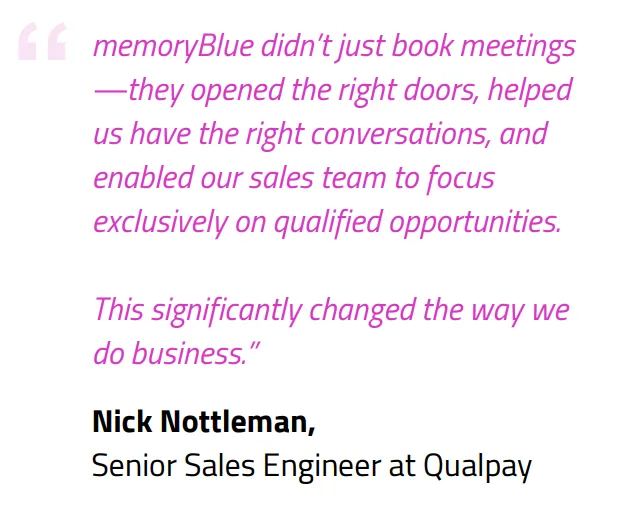
Qualpay saw the same strength in a much narrower market. It sells payment processing to fuel and propane delivery companies, many of them family-owned businesses with hard-to-reach decision-makers.
A previous outsourced partner had booked meetings that weren’t truly qualified. Since memoryBlue took over in October 2022, the program has generated $244 million in pipeline and $115 million in closed revenue, with an average lead score of 9.3 out of 10.
Where users praise DemandZEN
Users often point to how quickly DemandZEN gets a program off the ground, which is valuable for sales leaders who don’t have time to manage a long onboarding. As one G2 review put it:
“I like how flexible DemandZEN is, and how fast they’re able to get onboarded and started. It’s really refreshing that I didn’t have to do a massive amount of enablement or onboarding – I am leading my own team, so by hiring them I’m able to focus on my team while they provide value without significant lift.”
Other teams focus on how closely DemandZEN works toward the goals set at the start of an engagement. As this user explained:
“They have a clear goal in mind they strive for that aligns with our business requirements. They are very flexible and willing to adjust strategy at our request in order to help achieve the set goal.”
DemandZEN vs. memoryBlue: Which is the Better Choice for Your Sales Team?
As you’ve seen in this comparison so far, DemandZEN and memoryBlue can both get your AEs into qualified first meetings.
But that first meeting is usually just the start of a longer conversation with the account. Forrester’s State of Business Buying research found that, on average, 13 people are involved in a B2B buying decision.
memoryBlue can stay part of that conversation, with ADRs who work the wider buying group until an opportunity is ready for your AE. DemandZEN’s handoff usually comes earlier, at the first QA-checked meeting, and your AEs lead the account after that.
To see how memoryBlue’s SDRs and ADRs would work your buying committees, talk to the team about your targets and markets, and the pricing model that suits your goals.
FAQs
How do DemandZEN and memoryBlue approach outbound prospecting?
Both run multichannel outreach that combines cold calls, email, and LinkedIn, and both lean heavily on the phone. memoryBlue sets daily activity targets for each SDR of 100+ dials, 50+ emails, and 30+ LinkedIn touches. DemandZEN describes a similar mix of cold calling, email outreach, and LinkedIn prospecting.
Which provider is better suited for complex B2B sales cycles?
Complex deals involve several decision-makers, so look for a provider that researches the whole buying group and understands your industry.
Both companies support account-based programs. DemandZEN runs ABM for small groups of high-value accounts, and memoryBlue’s retainer can count account progress as well as meetings.
Industry knowledge helps too, since cybersecurity and fintech buyers expect reps who understand their world. memoryBlue lists both in the industries it supports, and DemandZEN works mainly with B2B tech and services companies.
Can outsourced SDR teams support existing demand generation campaigns?
Yes. memoryBlue’s SDRs can follow up on marketing leads, webinar and trade show registrations, and support ABM campaigns. Its mB Grow program also pairs memoryBlue-run marketing campaigns with SDR outreach. DemandZEN offers account-based marketing and demand generation programs alongside appointment setting.
In both cases, SDRs add speed and follow-through to pipeline generation, contacting new leads quickly and keeping target accounts engaged between campaigns.
What’s the difference between outsourced appointment setting and full-service sales outsourcing?
Appointment setting focuses on booking qualified meetings for your sales team. Full-service sales outsourcing can also cover lead qualification, nurturing, account development, and closing.
DemandZEN focuses primarily on appointment setting, with Demand FTE adding dedicated BDR capacity. memoryBlue covers both, with account development and closing roles available in the same engagement.
What are some alternatives to DemandZEN and memoryBlue?
It’s common to evaluate a few outsourced SDR providers side by side, since each handles outbound a little differently. Some of the names you’ll see most often:
- SalesRoads focuses on appointment setting and lead generation through outbound calling and personalized email.
- Belkins runs managed outbound programs and dedicated SDR teams, with a strong emphasis on cold email, deliverability, and appointment setting.
- Martal Group pairs experienced, fractional sales professionals with its own AI SDR platform, and offers tiered programs that can launch quickly.
- CIENCE backs its outsourced SDR teams with in-house research data and its own outbound technology.
- SalesHive provides US-based SDR teams working across email, phone, LinkedIn, and direct mail, supported by its own outbound platform.
- Callbox delivers multichannel lead generation and appointment setting, with especially wide reach in APAC and other international markets.
Other names that often come up include Leadium, Cleverly, EBQ, and Sales Focus Inc.