


An in-house SDR usually costs a lot more than the base salary on the offer letter. Recruiter fees, payroll taxes, benefits, a sales tech stack, and hours of manager time all add to the bill, and the new rep still needs a few months to book meetings at full pace.
The Bridge Group puts that ramp at three months, and the average SDR stays in the role for 1.9 years. That gives you roughly a year and a half after ramp-up from each hire.
That math leads many B2B companies to outsourced sales development. A partner recruits, coaches, and manages SDRs who work under your brand and toward your targets.
This guide covers how it works, when it fits, the key benefits, and costs.
What is outsourced sales development?
Outsourced sales development is a partnership in which a B2B company hires a specialized agency to manage top-of-funnel sales development. Some companies replace their in-house SDR team with the agency, and others bring outsourced reps to the team they already have.
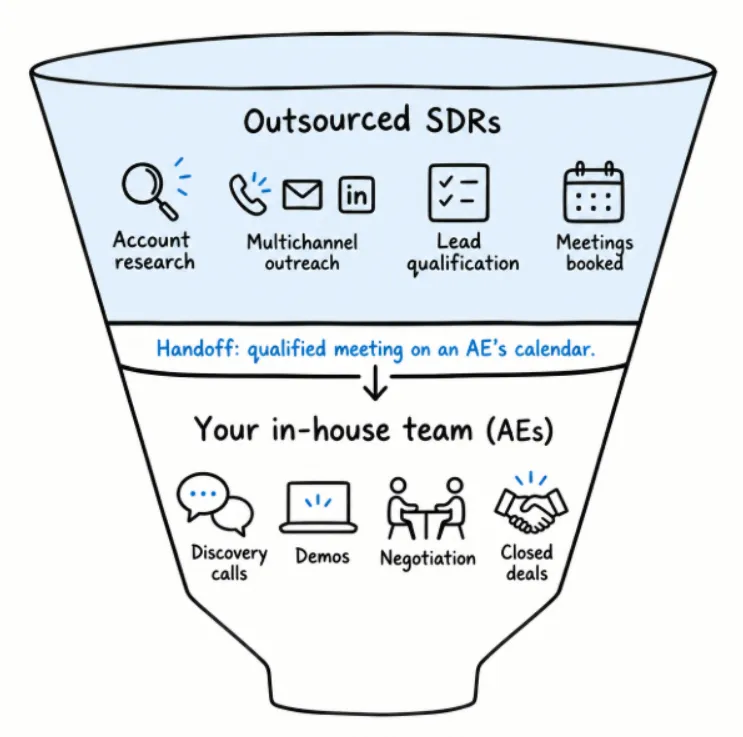
The agency’s SDRs cover the front-end work of the sales process. They identify target accounts, contact buyers by phone, email, and LinkedIn, qualify inbound and outbound leads, and book meetings for your account executives (AEs).
The work splits between the two teams along the funnel:
- Outsourced SDRs own top-of-funnel tasks. They find prospects, confirm fit and interest, and set appointments.
- Your in-house team owns bottom-of-funnel tasks. AEs hold demos, negotiate terms, and close deals.
The model is most common in high-growth B2B sectors such as tech, SaaS, cybersecurity, and professional services. In these markets, the average contract value (ACV) is high enough to justify the cost of human outreach.
For example → A cybersecurity vendor with a $60,000 ACV can recover months of outreach costs from a single closed deal. A tool priced at $1,200 per year would need dozens of new customers from the same rep to break even, so a self-serve or marketing-led sales motion usually fits it better.
Types of outsourced sales services
Outsourced sales can refer to several different service models, depending on how much of the sales process a company wants a partner to own. Some providers focus only on lead generation or appointment setting, while others take responsibility for a much larger part of the funnel.
The main difference is where the outsourced team enters the sales process and where it hands the opportunity back to your internal team.
| Service type | What the provider handles | Where your team takes over | Best fit for |
| Lead generation | Builds and enriches target contact lists, then creates interest through cold email, social outreach, or other demand-gen channels | Once a target contact shows interest or meets agreed criteria | Teams with their own SDRs that need more target contacts |
| SDR/BDR outsourcing | Dedicated reps prospect by phone, email, and LinkedIn, then qualify inbound and outbound leads | Once the prospect meets qualification criteria and is ready for an AE conversation | Companies that want steady qualified pipeline without adding SDR headcount |
| Appointment setting | Books qualified meetings and demos for internal closers | At the booked meeting | Sales teams with strong AEs but limited prospecting capacity |
| Full-cycle sales outsourcing | Covers outreach, qualification, demos, negotiation, and close | At contract signature or onboarding | New markets, new products, or companies without an established sales team |
| Inside sales services | Remote reps respond to inbound leads, nurture opportunities, and move deals forward by phone, email, and video | Varies by program (some hand off late-stage, while others close directly) | Companies with high inbound volume or relatively short sales cycles |
| Channel sales management | Recruits, enables, and manages resellers, distributors, and partners | Your team usually retains channel strategy and commercial control | Vendors that want indirect reach into new regions or segments |
In practice, many providers combine several of these services. memoryBlue, for example, offers SDR and ADR teams to build pipeline, AE and inside sales reps to move deals to close, plus marketing campaigns at the top of the funnel and retention and upsell programs for existing customers.
Good to know → Providers use these labels loosely, and one agency’s “appointment setting” may cover much of the same work as another agency’s “SDR outsourcing.” Compare vendors based on the specific tasks included, the qualification criteria they use, and the exact point where the handoff to your team happens.
How outsourced sales development works
Outsourced sales development starts inside your company with an internal assessment. A provider can only aim at goals you define, so write down these three things before you contact any vendor:
- Your goal, such as more first meetings, a new region, or faster replies to inbound leads
- Your buyers, including your ICP, target accounts, and key job titles
- Your metrics, such as meetings held, pipeline created, or cost per opportunity
Watch out ❗ → Booked meetings make a weak primary metric. A meeting counts as booked even if the prospect never shows up, so a program can hit its target while AEs face half-empty calendars. Track meetings held and the pipeline those meetings create.
This brief also makes partner selection easier. You can compare each provider against your goals, then ask how it hires and trains reps, where its contact data comes from, and whether its tools connect to your CRM system. We cover the full evaluation checklist later in this guide.
After you sign, the kickoff and alignment stage begins. The provider assigns dedicated reps and a delivery manager, and your team hands over the material the reps need to speak credibly about your product.
- Your ICP, buyer personas, and target account list
- Your value proposition and key messages for each persona
- Qualification criteria, such as BANT (budget, authority, need, timeline)
- Call recordings, case studies, and marketing content
Good to know → Share call recordings from your best AEs during kickoff. New reps learn which objections your buyers raise and how your team responds to them.
The provider then prepares its reps before they contact a single prospect. At memoryBlue, for example, this starts with a two-week setup period that isn’t billed. memoryBlue uses that time to pick the SDRs for your account and assign a delivery manager, and your team fills out a client information playbook.
A five-day onboarding plan follows:
- Day 1. The kickoff call covers the client information playbook, KPIs, and goals for the first 30 days.
- Day 2. Reps study your product and industry and build their first contact lists.
- Day 3. The team designs multichannel cadences, reviews messages, and starts role plays.
- Day 4. Reps finalize target lists by persona, lock in messages, and practice with more role plays.
- Day 5. Outreach begins.
Next comes execution. Reps contact prospects through a cadence, which is a planned series of phone, email, and LinkedIn touches spread over several weeks. Before outreach starts, they research and segment the target accounts, and they use buying signals such as new funding, a leadership change, or intent data to tie each message to the prospect’s situation.
Outbound prospecting is the core of most programs, and a trained SDR team can take on other campaign types too.
- Net-new outbound to accounts that match your ICP
- Inbound follow-up, with calls to new leads within minutes of a form fill
- MQL follow-up after events, webinars, and other marketing campaigns
- Upsell and cross-sell outreach to current customers
- Deal support to re-engage cold leads and bring more stakeholders into slow deals
For example → memoryBlue’s outbound SDRs average more than 100 dials, 50 emails, and 30 LinkedIn touches per day. The phone carries much of that load for a reason. In memoryBlue’s Spring 2025 benchmark report, phone calls produced 85% of booked sales meetings, with email at 8% and LinkedIn at 7%.
Once a prospect shows interest and meets your criteria, the SDR moves to the handoff. The rep books the meeting directly on an AE’s calendar and sends notes on the prospect’s needs, current tools, timeline, and other stakeholders in the account. The AE walks into the call with full context, and the prospect doesn’t have to repeat the same answers.
Watch out ❗ → Agree on the definition of a qualified lead in writing before launch. When the two teams use different definitions, AEs receive meetings they don’t want, and the feedback that reps get loses its value.
The final stage, optimization, keeps the program on track after launch. Your AEs score each meeting and share feedback on the ICP, messages, and offers. The provider combines that input with activity data to adjust target lists, cadences, and call scripts, and both teams review results in weekly, monthly, and quarterly check-ins.
Three rates show whether the program performs as planned.
- Connection rate is the share of dials that reach a live person.
- Conversion rate is the share of conversations that end in a booked meeting.
- Hold rate is the share of booked meetings that take place.
For reference → memoryBlue targets a 5 to 10% connection rate, a 15 to 20% conversion rate, and a 75 to 80% hold rate, and it expects reps to reach full pace after about 90 days. Judge the first month on activity and meeting quality, and set firm volume targets from month three.
Benefits of outsourcing your sales team
An outsourced SDR team can save your company time and money and reduce hiring risk. The provider recruits, trains, manages, and replaces the reps, and your team focuses on the deals they create.
Here are the main benefits of the model:
- Faster launch: A new in-house SDR starts with a recruitment process that can take weeks. Employ’s 2026 Hiring Benchmarks report found that average time to fill was 63.5 days in 2025. A provider already has trained reps on staff, so outreach can often start within a few weeks of the contract.
- Lower, more predictable cost: Base pay covers only part of what an SDR costs. The Bridge Group’s 2025 report puts median SDR on-target earnings at $80,000, and an in-house team also needs benefits, software, recruiter fees, and a manager with median on-target earnings of $146,000. An outsourced program can bundle many of these expenses into one predictable fee, which makes the sales budget easier to plan.
- Trained, vetted reps: Sales development is a hard role to succeed in, and The Bridge Group reports that only 60% of SDRs hit quota, the lowest share in the study’s history. Established providers screen and train reps at scale. memoryBlue, for example, puts every candidate through a 12-step interview process and every new hire through a six-week training academy, including reps with prior sales experience.
- Flexibility to scale: An outsourced program lets you add reps for a product launch or a new region, then reduce the team when plans change without having to restructure internal headcount. Providers with multilingual reps also make it easier to reach buyers in their own language.
- More time for AEs to sell: AEs who prospect on their own give up hours they could spend with buyers. Salesforce’s 2026 State of Sales report puts the average seller’s selling time at just 40% of the workweek. Dedicated SDRs take over account research and first outreach, so your AEs can focus on discovery calls, demos, and open deals.
- A path to full-time hires: Some providers let you hire an outsourced SDR onto your own team. You can review a rep’s results over several months before you make an offer, which lowers the risk of a bad hire. In 2024, 176 of memoryBlue’s 300 active clients hired their SDR this way.
How much does outsourced sales development cost?
Outsourced SDR pricing varies widely from one provider to the next. The final price depends on the pricing model, the scope of work, and where the reps are based.
The sections below cover the most common pricing models, the factors that raise or lower a quote, and how the total compares with the cost of an in-house team.
Pricing models breakdown
Most outsourced sales development providers use one of four pricing structures:
| Model | How it works | Typical published range | Best for |
| Monthly retainer | A fixed monthly fee per dedicated rep. Management and core tooling are often bundled, but inclusions vary by provider. | $3,000–$12,000 per rep per month | Companies that want dedicated reps and a steady, long-term program |
| Pay-per-meeting | A fee for each qualified meeting the provider books or holds | $200–$800 per meeting | Pilot programs, narrow niches, and tests of a new message or market |
| Hybrid | A lower base fee plus a bonus for each qualified meeting | Varies by provider | Companies that want the provider’s pay tied to meeting quality |
| Fractional SDR | Part of one rep’s time, shared with other clients | A portion of a full-time rep’s rate | Early-stage startups that need low-volume outreach before a full-time commitment |
Keep in mind that pay-per-meeting contracts reward volume. Check whether the provider bills for booked or held meetings, and how the contract defines a qualified meeting. A meeting-only model also leaves little budget for event invites, account-based marketing follow-up, and other outreach that doesn’t end in a meeting.
For example → memoryBlue offers two models. Its performance-based model pairs a lower base cost with a fee for each meeting held, and it suits fast campaigns and new-market tests. The standard retainer has a fixed, all-inclusive monthly price, supports other calls to action such as event invites and ABM follow-up, and typically costs about 7% less over the long term.
Key cost drivers
These few variables usually move the price within each model:
- Rep location: Onshore reps in the US or UK cost more than nearshore or offshore reps, and they bring native fluency and local business knowledge. In-office teams also cost more than remote contractors, since the provider pays for offices and on-site sales managers.
- Target market: Enterprise executives, public sector buyers, and technical personas take more research per account and more experienced reps. Programs aimed at mid-market managers with a simple offer cost less.
- Channel mix: Phone, email, and LinkedIn outreach together costs more than an email-only campaign, since the program needs dialers, call time, and reps trained for live conversations.
- Languages and regions: Outreach across several countries needs native speakers and knowledge of local privacy rules, and each added language raises the price.
- Program scope: Inbound follow-up, event promotion, upsell campaigns, and custom reports all add work on top of core outbound.
- What the fee includes: Some quotes leave out setup fees, contact data, or tool licenses. Ask each provider for an itemized quote so you can compare them on equal terms.
Comparing in-house vs. outsourced sales team costs
A fair comparison looks at the full cost of an in-house SDR, and salary is only one part of it. An internal team also pays for commission, benefits, payroll taxes, recruitment, sales technology, data, management, and ramp time.
The Bridge Group’s 2025 report puts median SDR on-target earnings (OTE) at $80,000 and median SDR manager OTE at $146,000. Benefits, taxes, tools, and recruitment costs come on top of those figures.
| Cost item | In-house SDR | Outsourced SDR |
| Salary and commission | $80,000 median on-target earnings | Covered by the program fee |
| Benefits and payroll taxes | Paid by your company | Covered by the program fee |
| Recruitment | Recruiter fees and weeks of interviews for each hire | Handled by the provider |
| Management | A dedicated manager, with median on-target earnings of $146,000 | Included in most retainer programs. Confirm whether a named manager owns your account or splits time across clients |
| Tools and data | CRM seats, dialer, sequencing tool, and contact data | Included in some quotes and billed separately in others. Ask for an itemized list |
| Training and ramp | About three months before a new rep reaches full pace | Reps complete training before outreach starts, and most programs reach full pace in about 90 days |
| Turnover | 40% median annual attrition, with a new search each time | The provider replaces reps, though a replacement still costs your account ramp time |
| Monthly cost | Salary, benefits, taxes, tools, and a share of management time | A single program fee per rep, with the range set by model and rep location |
Watch out ❗ → Providers scope these items differently, and a fee that includes contact data and tool licenses covers more work than one that excludes them. Ask each provider for an itemized quote before you compare the two columns, and price any excluded item back into the total yourself.
Outsourcing won’t always cost less. A company with experienced SDR leaders, proven processes, and a large team can manage an in-house function at a competitive cost per meeting.
Outsourcing saves the most when a company would need to recruit new reps, buy the supporting tools, add a manager, and pay for several months of ramp before the team reaches full productivity.
Example → Say an outsourced program costs $7,000 per month, and an in-house sales development representative has $6,700 in monthly on-target earnings. The two numbers look close at first. The in-house figure grows once you add benefits, payroll taxes, software, management time, recruitment, and salary paid during ramp, so compare the two options by the total cost to create qualified pipeline.
| PRO TIP → Run your own numbers before you request quotes. memoryBlue’s cost calculator compares in-house and outsourced SDR costs side by side, which gives you a baseline to hold each provider’s quote against. |
When should you consider outsourced sales development services
Outsourced sales development works best when you need pipeline soon, lack the internal setup for an SDR team, or want to test a new sales motion before you commit to headcount.
These are the most common cases:
- Your AEs need more meetings this quarter: An outsourced team can start outreach within a few weeks, often before an in-house hire would finish the recruitment process.
- You plan to enter a new region or vertical: A provider with native speakers and local market knowledge can test demand in a new country or industry before you hire a local team.
- You have a new product to launch: Outsourced reps can test messages and personas for the new offer and show which buyers respond, and your current SDRs stay focused on their existing accounts.
- Your SDR team is too small for a dedicated manager: A team of two or three sales development reps rarely justifies a full-time manager, so coaching often falls to sales leaders with full schedules. A provider includes management and coaching in its fee.
- You want proof that outbound works before you build a team: An outsourced program shows which messages get responses and what a qualified meeting costs for your ICP. Some providers also let you hire the reps who perform best.
- Inbound leads wait too long for a reply: Many prospects lose interest when a form fill goes days without a call. Outsourced SDRs can contact each new lead within minutes and qualify it before it reaches an AE.
Good to know → An in-house team often suits companies with a long, technical sale and a product that takes months to learn. Many of these companies still use outsourced reps for side projects such as event follow-up or new regions.
| PRO TIP → Two of these cases point to the same feature. If you want proof that outbound works before you build a team, look for a provider that lets you keep the reps who prove it. memoryBlue’s Rising Stars path works this way, and 176 of its 300 active clients hired their SDR permanently in 2024. |
In-house sales team vs. outsourced vs. AI SDR: Which model is right for your organization?
B2B companies can build pipeline with an in-house SDR team, an outsourced team, or AI SDR tools. Each model fits a different budget, deal size, and level of management capacity.
The table below compares all three side by side:
| Factor | In-house team | Outsourced SDRs | AI SDR tools |
| Time to launch | About two months to hire, then about three months to ramp | A few weeks to start outreach | Days to set up |
| Upfront investment | High, with recruitment, tools, and a manager | Moderate, with one monthly fee | Low, with a software subscription |
| Management needs | A dedicated SDR manager | The provider manages reps, and your team gives feedback | RevOps or sales ops staff to configure and monitor the tool |
| Best ACV fit | Mid to high | Mid to high | Often lower-ACV, transactional deals |
| Live conversations | Strong once reps learn the product | Strong, with trained reps on the phone | Some tools now place calls and qualify prospects, though most programs still run on email and chat |
| Product knowledge | Deepest over time | Grows over the engagement | Limited to the content you provide |
| Scalability | Slow, since each new rep needs a new search | Fast, with reps added or removed within contract terms | Fast for volume, with quality tied to your data |
| Turnover risk | Yours to manage | The provider replaces reps | None, though the tool needs regular upkeep |
- Choose an in-house team if you have experienced SDR leaders, a proven playbook, and a product that takes time to learn. This model gives you direct control over hiring, coaching, and messages, and it usually needs a larger upfront investment in recruitment, tools, and management. It can also suit companies that use the SDR role as a path into AE jobs.
- Choose outsourced sales development if you need pipeline within weeks, lack a dedicated SDR manager, or want to test a new market or product before you hire. It often fits mid- to high-ACV deals, where reps need account research, personalized messages, and live conversations with several stakeholders.
- Choose AI SDR tools if you sell a lower-priced product at high volume, or need help with repeatable tasks such as lead enrichment, first-touch emails, follow-ups, and inbound lead routing. These tools usually fit best with simple offers, short sales cycles, and buyers who don’t expect a phone call.
| Note for reader → Many teams pair AI tools with human reps. AI handles account research, data enrichment, and first drafts, and reps handle calls, objections, and multi-threaded deals. At memoryBlue, for example, SDRs use AI tools for this kind of support, and only with client approval. |
What to look for in an outsourced sales development company
An outsourced SDR team contacts your buyers under your company name, so the provider you choose affects your brand and your pipeline. Many providers use similar terms on their websites and in sales calls, and the differences show up in how they hire, train, report, and contract.
Look closely at these areas as you compare them.
- Experience in your market: A strong provider has case studies from companies with a similar product, buyer, and deal size. Reps with a background in cybersecurity or public sector sales, for example, already know the personas, objections, and buying cycles in those markets.
- Rep quality and training: Reputable providers follow a structured hiring process and put every new rep through formal training before launch. Average SDR tenure also says a lot about a provider, since high turnover means repeated onboarding on your account.
- Reports and transparency: Look for real-time dashboards or weekly reports with meetings held, conversion rates, and pipeline created. Call recordings and AE feedback scores help you judge the quality of each meeting as well as the volume.
- Dedicated or shared reps: Dedicated reps work only on your account and learn your product and buyers in more depth. Shared reps split their time across several clients, which usually lowers the price and limits each rep’s focus.
- Data and tools: Find out where the contact data comes from, how often the provider verifies it, and whether reps work inside your CRM. Check who keeps the contact data and activity records if the contract ends.
- Reviews and references: Read verified reviews on G2 or Clutch, and ask to speak with current clients in your industry.
| Steal this provider evaluation checklist → ☐ Case studies from companies with a similar product, ICP, and deal size ☐ A clear hiring process and training program for new reps ☐ Dedicated reps assigned only to your account ☐ Verified contact data, with reps who work inside your CRM ☐ A written definition of a qualified meeting ☐ Reports on meetings held, conversion rates, and pipeline created ☐ Access to call recordings and AE lead scores ☐ A named delivery manager and a regular review schedule ☐ A rep replacement policy with clear timelines ☐ An itemized quote that lists setup, data, and tool costs ☐ Clear terms for contract length, notice period, and team changes ☐ Verified reviews and client references in your industry |
Top 3 Sales development companies to consider
These three providers show how differently agencies can approach the same work, from full-service global programs to AI-assisted email campaigns and phone-led outreach in North America.
1. memoryBlue
memoryBlue is an outsourced sales development and go-to-market services provider for B2B companies. Its model combines dedicated SDR, ADR, and AE teams with targeting, multichannel outreach, qualification, sales technology, and reporting.
It also offers training, recruiting, and marketing support, so clients can outsource one part of the revenue process or several connected functions through the same partner.
When is memoryBlue the right choice for your team → memoryBlue is a strong fit for B2B technology companies that want a fully managed sales development team without limiting the engagement to appointment setting. It works especially well if you need dedicated SDRs, global coverage, structured management, and the option to expand into later-stage sales support as the program grows.
Compared with other providers → Many outsourced sales providers focus primarily on prospecting and booked meetings. memoryBlue covers a broader part of the revenue function through its SMART model, which brings marketing, training, recruiting, and sales technology around the core SDR program.
Key features
- Fully managed SDR and AE teams: memoryBlue assigns dedicated reps who prospect under your brand across phone, email, and LinkedIn, backed by a delivery manager and a managing director on every program. Support runs full-cycle or partial-cycle, from first outreach through account management, so you can start with meetings and add later-stage coverage when you need it. The company works from an in-office delivery model, with 650+ SDRs coached daily by managers and directors.
- Rising Stars, the audition-to-hire path: Clients can bring a memoryBlue rep onto their own payroll at any point in the engagement, which gives you months of performance data before you make an offer. More than 1,000 SDRs have moved to client teams this way, and 176 of memoryBlue’s 300 active clients hired their rep in 2024 alone.
- Academy sales training: Every new hire completes the same Academy curriculum that memoryBlue uses for its own 650+ reps, which includes an immersive bootcamp followed by five weeks of coaching. Training continues after launch through advanced coaching, mock-call technology, and real-time benchmarks. Your in-house team can use the Academy too, since memoryBlue sells the program separately for internal sales teams.
- Technology and real-time reports: memoryBlue connects to your CRM and orchestrates outreach across your existing stack, so activity and results stay visible in the systems your team already uses. Its proprietary data warehouse, live lead scoring, and client portal show activities, conversations, meetings scheduled and held, and connection, conversion, and hold rates. The company describes its AI approach as assistive, with tools that support reps instead of replacing them.
- Marketing that feeds outbound: Marketing as a Service gives SDR programs the offers they need, from webinars and ABM microsites to event campaigns and nurture sequences. The team also builds assets, talk tracks, and dashboards for the reps, which keeps messages consistent across marketing campaigns and outbound calls.
- Recruiting from a 1,200-plus alumni network: memoryBlue recruits SDRs, AEs, and sales leaders for clients who want to build in-house, and its packages cover single hires, team builds, seasonal surges, and ongoing recruitment support. Time-to-hire averages 16 days with an 80% fill rate, well above the 20% to 30% industry average.
What real users are saying
The managed service model comes up a lot in memoryBlue reviews. Clients describe an outbound program that runs without pulling their own managers into recruitment, coaching, or daily oversight. One G2 user explained it this way:
“What also stands out most is their completely managed service model, which drastically minimizes our internal operational overhead. Instead of us having to recruit, train, and babysit the day-to-day sales pipeline, memoryBlue handles the entire SDR and ISR infrastructure seamlessly. It gives us the best of both worlds: a highly structured, professional outbound email engine and consistently great results without the management headache.”
Market knowledge is the other theme in the reviews. Public sector buyers work on long cycles and through gatekeepers, and users credit memoryBlue’s reps with an understanding of how those deals move. Another G2 user describes that, along with the communication around the program:
“Their experience in the public sector is noticeable, and they understand long sales cycles and getting through gatekeepers. They’re phenomenally transparent, attentive, and communicative, even meeting with us in person, which is pretty rare.”
The published results point the same way. memoryBlue’s Motorola Solutions case study covers a 20-month public sector program that generated 1,339 sales-qualified leads at an average lead score of 9.1 out of 10.
2. Martal Group
Martal Group provides outsourced lead generation, appointment setting, and full-cycle sales services through a team of more than 200 sales executives in North America, the EU, and Latin America.
Its in-house AI platform builds intent-based lead lists, writes email copy, and adjusts active campaigns through multivariate tests.
When is Martal Group the right choice for your team → Martal Group fits B2B companies that want experienced, onshore reps for outreach in North America, Europe, or Latin America, supported by AI tools for lead lists and email campaigns. It can also suit teams that may later want help with deal negotiation or account management.
Compared with other providers → Martal differs from narrower appointment-setting firms by covering a broader portion of the funnel, from outbound prospecting through later-stage sales support.
Key features
- Experienced onshore reps: Martal’s team of more than 200 sales executives works from the US, Canada, the EU, and Latin America, and the company recruits mid- and senior-level B2B sales talent. According to Martal’s website, about 60% of the team is based in the US, 20% in Canada, and 10% each in the EU and Latin America.
- Omnichannel outreach with deliverability controls: Campaigns combine cold email, LinkedIn follow-ups, and calls through a power dialer. Each sales executive sends email from a custom domain that Martal’s deliverability specialists manage.
- Proprietary AI outreach system: During onboarding, the platform creates a business profile and ICP descriptions, and then builds lead lists with intent and technographic filters. Martal says its copy tool is trained on more than 40 million of the company’s top-performing emails, and the team reviews and edits each draft before launch.
What real users are saying
Users often point to how fast Martal’s team learned their product and market. Several also credit the reps with advice on subject lines, message strategy, and sequence design that lifted response rates. This G2 user sums up both:
“The most impressive part of working with Martal was their ability to get up to speed on our value proposition and market quickly. Their SDRs and campaign strategists felt like an extension of our team, not just a vendor executing tasks.
They also brought valuable insight into outbound best practices, including subject lines, messaging strategy, and sequencing, which helped improve our response rates and engagement.”
The main concern that appears in feedback is depth within very narrow target markets. A user noted that while the team stayed responsive and engaged, outreach into highly specialized security segments did not consistently create enough pipeline to support the long-term investment.
“The primary challenge was achieving the depth of market penetration we required for our most specialized niche segments. While the team was responsive and engaged, the breadth of their reach into these specific, highly targeted security verticals did not consistently generate the level of pipeline we needed to justify the long-term investment.”
Learn more → Competitive comparison: memoryBlue vs. Martal Group
3. SalesRoads
SalesRoads is a B2B sales outsourcing agency that provides outsourced SDR teams, appointment setting, and lead generation for companies.
Each program combines dedicated SDRs with a client strategist, a performance coach, and a research and data team.
When is SalesRoads the right choice for your team → SalesRoads suits B2B companies that want experienced reps on the phone with North American buyers, plus a full support team around each SDR. Its month-to-month terms are also good for teams that want to test outsourced sales development without a long commitment.
Compared with other providers → SalesRoads sells its programs month to month with the option to cancel at any time, while several providers in this category ask for a three- to six-month minimum term.
Key features
- Career sales reps: SalesRoads assigns one rep per client program, never shared across accounts, and its pricing page states that a dedicated SDR averages 14 years of sales experience.
- A support team around each SDR: Every program includes a client strategist who owns performance against your goals, an SDR performance coach who trains reps from live call listening, a research and data team responsible for list building, data verification, and CRM integration, and an optimization specialist who reviews metrics week over week and adjusts targeting, talk tracks, and cadence after launch.
- Month-to-month terms: SalesRoads advertises no long-term commitment and the option to cancel at any time. Its published base price is $11,950 per four-week period for one dedicated SDR, and the cost per rep falls as the team grows, down to $8,375 per rep at two SDRs.
What real users are saying
Some clients note that SalesRoads’ methods feel traditional, but they report strong results anyway. This G2 review describes record numbers on demos and closed deals:
“Some of their methods and procedures are older school, but they delivered great results. In fact, they helped us achieve all time company records for most demos scheduled, held, and wins. During our time working together, we became true partners.”
One common concern involves how SalesRoads promotes its own reps. A strong performer on your campaign may move up internally, which means a new rep on your account. The same G2 user describes the trade-off:
“Their internal model for recognizing and promoting SDRs is great for them/their talent, but tough on their clients. For example, when an SDR performs very well on a client’s campaign, they will likely be moved off the campaign at some point into a higher level position.”
Take the risk out of sales development with memoryBlue

Building an SDR function internally means you take on recruitment, training, management, technology, and months of ramp before the team books its first meetings.
memoryBlue handles all of it in one managed model, with sales teams assigned to your accounts alone, from top-of-funnel prospecting through later-stage sales work. The company has spent more than 20 years with B2B technology companies, and it ranks first on G2’s grids for both Lead Generation Companies and Outsourced Sales Companies.
With memoryBlue, you get:
- Dedicated teams without the infrastructure work, including SDR, ADR, and AE support alongside delivery management, coaching, reporting, and sales operations.
- Reps trained before they call your market, through a 12-step interview process and the six-week memoryBlue Academy.
- A lower-risk path to internal hiring, since 176 of memoryBlue’s 300 active clients hired their SDR permanently in 2024.
- Support past appointment setting, with programs that cover part or all of the sales cycle, from outbound prospecting through account management.
- Global outreach without separate local teams, across North America, EMEA, APAC, and LATAM in more than 30 native languages.
- Full visibility into performance, through a real-time client portal and weekly, monthly, and quarterly reviews.
- A wider GTM model, where SMART adds marketing, Academy training, recruiting, and technology to your sales program.
If you need more pipeline and would rather not build the whole sales development operation yourself, book a strategy call to talk through your target market, sales motion, and the right level of support.
You can also compare the numbers first with memoryBlue’s in-house vs. outsourced cost calculator.
FAQs
What does an outsourced SDR company do?
An outsourced SDR company supplies trained sales development reps who prospect on your behalf.
Most outsourced SDR services cover the same scope, which includes account research, cold outreach by phone, email, and LinkedIn, lead qualification against criteria you set, and meetings booked directly on your AEs’ calendars.
Your own team keeps control of the ICP, the messages, and every deal that follows the first meeting.
Does cold calling still work in B2B sales?
Yes. In memoryBlue’s Spring 2025 benchmark report, cold calling accounted for 85% of meetings booked, compared with 8% from email and 7% from LinkedIn.
Email and LinkedIn still play a part in most sales strategies, since they warm up accounts and keep your name in front of buyers between calls.
How do outsourced SDRs produce high-quality leads?
Quality starts with the criteria your team defines, since a sales outsourcing company can only qualify against the rules it receives.
Strong programs pair that definition with account research, buying signals such as new funding or a leadership change, and a feedback loop where AEs score each meeting.
Providers then use those scores to refine target lists and messages, which raises the share of high-quality leads over the first few months.