Cold calling has been declared “dead” more times than most sales leaders can count. But in reality, it is not dead. It is evolving.
With AI now influencing nearly every part of the sales process, from automated outreach and call preparation to synthetic voice technology and real-time coaching tools, it is fair to ask what role cold calling still plays in building pipeline. The answer is not that AI replaces the cold call. The answer is that AI can make the cold call smarter, more strategic, and more effective when it is paired with the human skills that buyers still respond to most.
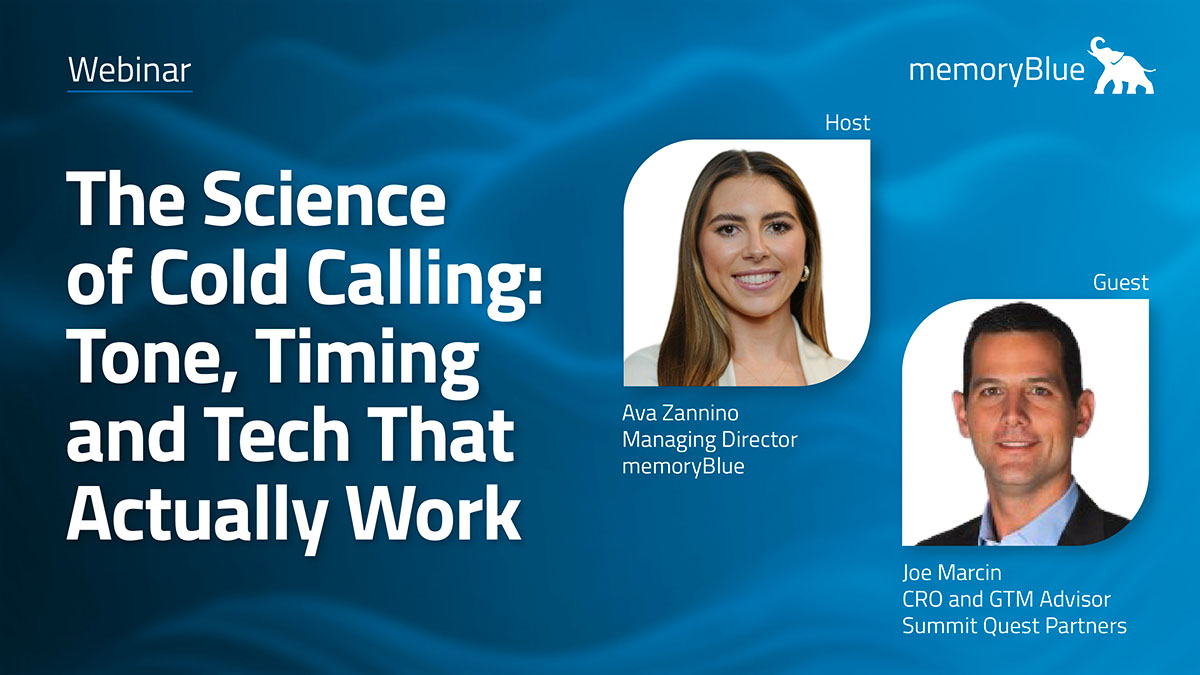
In memoryBlue’s webinar, The Science of Cold Calling, Ava Zannino, Senior Managing Director at memoryBlue, sat down with Joe Marcin, a three-time award-winning Chief Revenue Officer and go-to-market advisor, to discuss how cold calling is changing and what still makes it work.
You can watch the full webinar here: The Science of Cold Calling: Tone, Timing, and Tech That Actually Work
AI Should Amplify Sales Development, Not Replace It
AI has become one of the biggest topics in go-to-market strategy, and sales development is no exception. From automated messaging to AI-generated voicemails, teams are experimenting with ways to move faster, personalize better, and reach more buyers.
But speed and automation only go so far.
As Joe explained during the webinar, buyers still want to feel understood. Even when an AI-generated voicemail is articulate and personalized, it can miss the mark if the tone feels off or the message does not create a real connection. That matters because sales is still built on trust. Companies may buy from companies, but the actual transaction happens between people.
Where AI becomes most valuable is in helping sales development representatives do their job better. It can shorten research time, help reps understand a prospect’s role, surface company or industry insights, and even support reps in real time with suggested talking points. Used well, AI can raise the level of preparation and confidence going into a call.
The risk comes when organizations treat AI as a replacement for the human element. Today’s buyers are busy, skeptical, and inundated with outreach. What breaks through is not just a message that is technically accurate. It is a message delivered with relevance, empathy, and presence.
Tone, Energy, and Presence Matter More Than Most Teams Realize
A strong cold call is not only about what a rep says. It is about how they say it.
Tone, pace, confidence, and energy shape how a buyer receives the message. This is especially true when calling executives. As Joe noted, sales professionals often get delegated to whom they sound like. If a rep calls an executive but lacks confidence, speaks too quickly, or brings the wrong level of presence, the executive may disengage or redirect them to someone else.
Executive conversations require executive presence.
That does not mean every SDR needs to know every answer or speak like a tenured CRO. It means they need to sound prepared, composed, and credible. They need to project confidence in the problem they are helping solve and bring enough energy to make the conversation feel worth the buyer’s time.
This is also why environment matters. Remote work has changed where many sales calls happen, but it should not change how reps show up. Standing up, dressing the part, and creating a focused call environment can all influence how a person sounds on the phone. Buyers may not see the rep, but they can hear the difference.
Scripts Are Useful, But Only When They Become Your Own
Scripts are an important part of sales development. They provide structure, help reps stay focused, and give teams a consistent framework for opening calls, handling objections, and guiding conversations.
But a script should not sound like a script.
When reps read word-for-word, they risk losing authenticity. Buyers can hear when someone is reading, stumbling through lines, or clinging too tightly to a prewritten path. The goal is not to abandon scripts completely. The goal is to internalize them.
A strong script gives reps the foundation. Practice gives them the confidence to make it their own.
That is where role plays, mock calls, peer coaching, and repetition become critical. Reps need to practice their delivery before they are live with a prospect. As Joe put it, it is not just practice that makes perfect. It is perfect practice that makes perfect.
One helpful exercise discussed in the webinar is taking the script away and asking reps to explain the value proposition in their own words. This reveals what they truly understand, where they need more coaching, and how naturally they can communicate the message. The more internalized the script becomes, the more authentic the conversation feels.
There Is No Perfect “Golden Hour” for Cold Calling
Many sales teams rely on set calling windows or blitz times. Structured call blocks can be incredibly valuable because they create focus, accountability, and momentum across the team.
But one of the biggest takeaways from the webinar is that there is no universal golden hour.
Executives and buyers have different schedules depending on their role, industry, geography, company priorities, and time of year. A financial services prospect may be unavailable when the market opens. A sales leader may be tied up with forecast calls on Monday morning. An HR executive may have different availability depending on hiring cycles, internal meetings, or company size.
That is why strong outbound teams test, vary, and refine their calling windows. Instead of assuming one time block works for everyone, reps should think about the buyer’s day. When are they most likely to be in meetings? When might they have space between priorities? When are they likely to be checking messages or catching up?
AI can help here, too. Reps can use AI tools to better understand a persona, industry, or role and make educated decisions about when to reach out. The point is not to find one perfect time. The point is to build a smarter calling strategy based on the buyer.
“Imperfect” Call Times Can Create Hidden Opportunities
Holidays, summer months, end-of-year budgeting, and other “bad” times to prospect are often treated as reasons to pause outbound activity. But those periods can actually create opportunities.
During slower or unusual business periods, competitors may pull back. That gives persistent and thoughtful teams a chance to stand out. Executives may still be working, even if their support teams are out. Out-of-office replies can reveal alternate contacts, cell numbers, or helpful context. Calls may route to another stakeholder who can influence the buying process.
The key is to approach these moments with empathy.
A holiday season call should not sound like a hard push for an immediate meeting. Instead, it can acknowledge the timing and focus on scheduling a conversation for a later date. For example, a rep might say that they know it is a busy time and are not trying to take up the prospect’s day, but would like to find time in early January to discuss a relevant priority.
That shift matters. It shows respect for the buyer’s time while still keeping momentum alive.
Cold Calling Works Best as Part of an Omnichannel Strategy
Cold calling is one channel within a larger outbound motion. Buyers consume information in different ways, which means reps need more than one path to reach them.
Some prospects may not answer calls but will read an email. Others may engage on LinkedIn. Some may respond to a short video. The most effective outbound strategies use multiple channels in a thoughtful, connected way.
The key is choreography.
A call, voicemail, email, LinkedIn touch, and video should not feel like disconnected attempts to get attention. They should tell a consistent story. Each touchpoint should build on the last one and give the prospect more context about why the rep is reaching out.
For example, a voicemail might mention that the rep will send a LinkedIn note with more information. Then, when the LinkedIn request arrives, it feels connected rather than random. This turns persistence into professionalism.
That is the difference between being professionally persistent and simply overwhelming a prospect.
The Best Cold Callers Lead With Mindset
Cold calling is challenging. Rejection is part of the job. Some prospects will not answer. Some will object. Some may even be rude. That is why mindset is one of the most important traits in sales development.
The best reps understand that their work matters. They are not just making calls for the sake of activity. They are identifying the buyers who have a real problem, starting conversations, and creating opportunities for their company and their customers.
That mindset helps reps stay consistent, confident, and coachable.
When paired with preparation, strong tone, thoughtful timing, and a connected omnichannel strategy, cold calling remains one of the most powerful tools for building pipeline.
Cold Calling Is Not Dead. It Is Evolving.
AI will continue to change the way sales teams work. It will help reps research faster, personalize better, and prepare more effectively. But it will not remove the need for human connection.
The fundamentals still matter.
Preparation matters. Tone matters. Presence matters. Empathy matters. Timing matters. Authenticity matters.
The future of cold calling is not about choosing between AI and people. It is about using technology to elevate the people making the calls.
To hear the full conversation and learn more about how sales teams can refine their outbound strategy, watch the full webinar here: The Science of Cold Calling: Tone, Timing, and Tech That Actually Work